
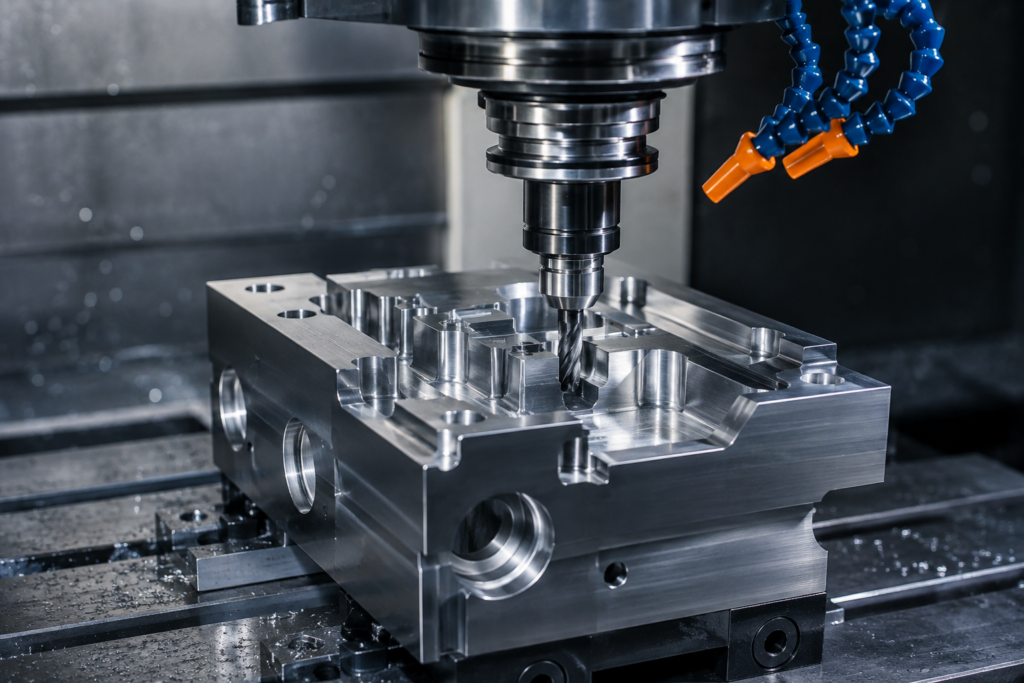
When a manufactured component needs consistent dimensions, repeatable results, and reliable performance, precision CNC machining becomes an important part of the production process. From prototypes and custom components to short and long production runs, CNC machining allows manufacturers to produce complex parts directly from engineering drawings and digital designs.
For Canadian manufacturers, choosing the right machining partner is about more than finding a supplier with CNC equipment. Material experience, machining capabilities, inspection procedures, production capacity, and the ability to understand engineering requirements all influence the final quality of a component.
This guide explains what precision CNC machining involves, the processes commonly used, materials that can be machined, and what Canadian businesses should consider when selecting a machining supplier.
What Is Precision CNC Machining?
Precision CNC machining is a subtractive manufacturing process in which computer-controlled equipment removes material from a workpiece to create a component according to a specified design.
CNC stands for Computer Numerical Control. Instead of manually controlling cutting tools, the machine follows programmed instructions generated from the component’s CAD/CAM data. This allows manufacturers to produce repeatable parts while maintaining control over dimensions, features, and production processes.
Precision machining is particularly useful when components have:
- Detailed or complex geometries
- Critical dimensions
- Multiple machining features
- Repetitive production requirements
- Specific material requirements
- Tight engineering specifications
The appropriate machining process depends on the geometry of the part. CNC milling is commonly used for components with pockets, slots, holes, contours, and other non-rotational features, while CNC turning is suited to cylindrical and rotational components such as shafts, bushings, and fittings.
Why Precision CNC Machining Matters for Canadian Manufacturers
Manufacturers often need parts that fit correctly with other components and perform consistently throughout their service life. A dimensional variation that seems small on an individual component can become a larger problem when parts are assembled in production.
This is why precision CNC machining services are valuable for industries that depend on repeatability.
A capable machine shop should consider more than simply removing material. The process involves reviewing drawings, selecting suitable machining methods, choosing tooling, monitoring production, and inspecting finished components.
For Canadian companies, working with a local or Canada-based machining supplier can also simplify communication, engineering discussions, shipping coordination, and production planning.
CNC Milling and Turning for Precision Components
Two of the most widely used CNC processes are milling and turning.
CNC Milling
CNC milling uses rotating cutting tools to machine features into a stationary workpiece. It can be used for components containing:
- Slots
- Pockets
- Holes
- Contoured surfaces
- Flat surfaces
- Complex 2D and 3D features
Perfect Machining and Services states that its CNC milling capability can handle components up to 50 × 28 × 20 inches, including 4th-axis, 2D, and 3D machining for extruded, forged, and cast components.
This makes milling suitable for a broad range of custom components where part geometry cannot be produced efficiently through turning alone.
CNC Turning
CNC turning is designed primarily for rotational parts. During turning, the workpiece rotates while cutting tools remove material to achieve the required diameter, length, grooves, threads, and other features.
Perfect Machining’s stated turning capability covers parts from 1/8-inch through 17-inch diameter and up to 72 inches in length, with a 3-inch spindle through bore.
The correct process depends on the component’s design, dimensions, material, quantity, and required features.
Materials Used in Precision CNC Machining
One of the most important factors when selecting a machining company is its experience with the material specified for your component.
Different materials behave differently during machining. Tool selection, cutting parameters, heat generation, tool wear, chip formation, and finishing requirements can all vary.
Common materials used for precision machined components include:
Aluminum
Aluminum is widely used where low weight, machinability, and corrosion resistance are important. It is common in housings, brackets, structural components, and other engineered parts.
Stainless Steel
Stainless steel is selected when corrosion resistance, strength, and durability are important. It can require careful machining because some grades generate more tool wear and heat than easier-to-machine materials.
Steel and Alloy Steel
Steel and alloy steel are commonly used for structural and high-strength components. The appropriate machining approach depends on the specific grade and hardness.
Brass and Copper
Brass is frequently used for fittings, connectors, and other components requiring good machinability. Copper is valued for electrical and thermal conductivity but can require appropriate tooling and machining parameters.
Engineering Plastics
Engineering plastics such as UHMW and Delrin can be machined for applications requiring wear resistance, low friction, lightweight components, or non-metallic parts.
Perfect Machining and Services works with stainless steel, aluminum, brass, copper, steel, alloy steel, and various plastics, along with materials such as tool steel and engineering plastics including UHMW and Delrin.
Precision Metal Machining Services for Different Production Volumes
Precision machining is not limited to large production orders. The right machining process can support a component throughout different stages of development.
Prototype Machining
A prototype allows engineers and manufacturers to evaluate a component before committing to larger production quantities. CNC machining is useful for prototypes because the same general manufacturing approach can often be adapted as the design moves toward production.
Short Production Runs
Short runs can be useful when demand is limited, a product is being introduced, or components are required for a specific project.
Long Production Runs
For ongoing production, repeatability becomes especially important. The machining process needs to consistently produce components that meet the specified requirements throughout the run.
Perfect Machining offers prototype, short-run, and long-run production for CNC machining, fabrication, and conventional machining components.
How Quality Control Supports Precision Machining
Quality control should not be treated as something that happens only after machining is complete. A reliable manufacturing process incorporates inspection at different stages.
Perfect Machining describes a three-stage inspection approach:
First Article Inspection: The first completed part is checked and its dimensions are recorded on a First-Off report.
In-Process Inspection: Components are inspected during production to help maintain dimensional consistency and identify issues before they affect a larger quantity.
Final Inspection: Finished components are inspected before shipment, including dimensional checks and, where required, verification of finishes, coatings, and appearance. The company also states that 100% inspection can be performed when required by customer specifications.
For buyers seeking high precision CNC machining, understanding how a supplier controls quality can be just as important as reviewing its machine list.
Industries That Use Precision CNC Machined Parts
Precision machined components are used across many Canadian industries.
Depending on the application, CNC-machined parts may be required for:
- Automotive manufacturing
- Defense applications
- Electrical equipment
- Electronics
- Hydraulic fittings and connectors
- Hardware and fasteners
- Industrial equipment
Each industry can have different requirements for materials, dimensions, finishes, quantities, documentation, and inspection. A machining supplier should therefore understand the requirements of the application rather than treating every component as a standard job.
How to Choose a CNC Machining Company in Canada
Choosing a CNC machining company in Canada should start with your actual part requirements.
Before requesting a quote, consider these factors:
1. Review Machine Capacity
Check whether the supplier’s machining envelope can accommodate the largest dimensions of your component.
2. Confirm Material Experience
Ask whether the shop regularly machines your specified material and grade.
3. Discuss Inspection Requirements
If your component contains critical dimensions or tolerances, understand how the supplier handles first article, in-process, and final inspections.
4. Consider Secondary Operations
Some projects require more than machining. Laser cutting, forming, welding, or other fabrication processes may also be necessary.
Having multiple capabilities with one supplier can reduce the number of manufacturing handoffs.
5. Provide Complete Engineering Information
A detailed drawing, material specification, quantities, tolerances, surface finish requirements, and relevant GD&T information can help a machining company prepare a more accurate quotation.
Why Work With a Canadian Precision Machining Supplier?
For businesses operating in Canada, working with a local machining partner can offer practical advantages. Communication is generally easier when engineering teams and suppliers operate within the same market, while local manufacturing can also simplify logistics and production coordination.
Perfect Machining and Services is based in Mississauga, Ontario, and has more than 15 years of experience manufacturing precision components. Its capabilities include CNC milling and turning alongside laser cutting, forming, and MIG/TIG welding.
The company serves industries including automotive, defense, electrical, electronics, hydraulic fittings and connectors, and hardware and fasteners.
Final Thoughts
The right precision CNC machining services can help Canadian manufacturers produce reliable components for prototypes, short runs, and ongoing production. However, precision is not determined by the CNC machine alone.
Equipment capability, material knowledge, engineering review, process control, inspection, and production experience all contribute to the final result.
When comparing precision CNC machining in Canada, look beyond a basic service list. Ask about the supplier’s machining capacity, materials, inspection procedures, production volumes, and ability to support your project from prototype through production.
For manufacturers in Mississauga and across Canada, selecting a machining partner that can understand the engineering requirements and provide consistent manufacturing support can make the difference between simply producing a part and producing one that performs as intended.