
Choosing the right material is one of the most important decisions when ordering CNC machining services in Canada. Material selection affects part strength, durability, corrosion resistance, machinability, weight, surface finish, cost, and overall performance.
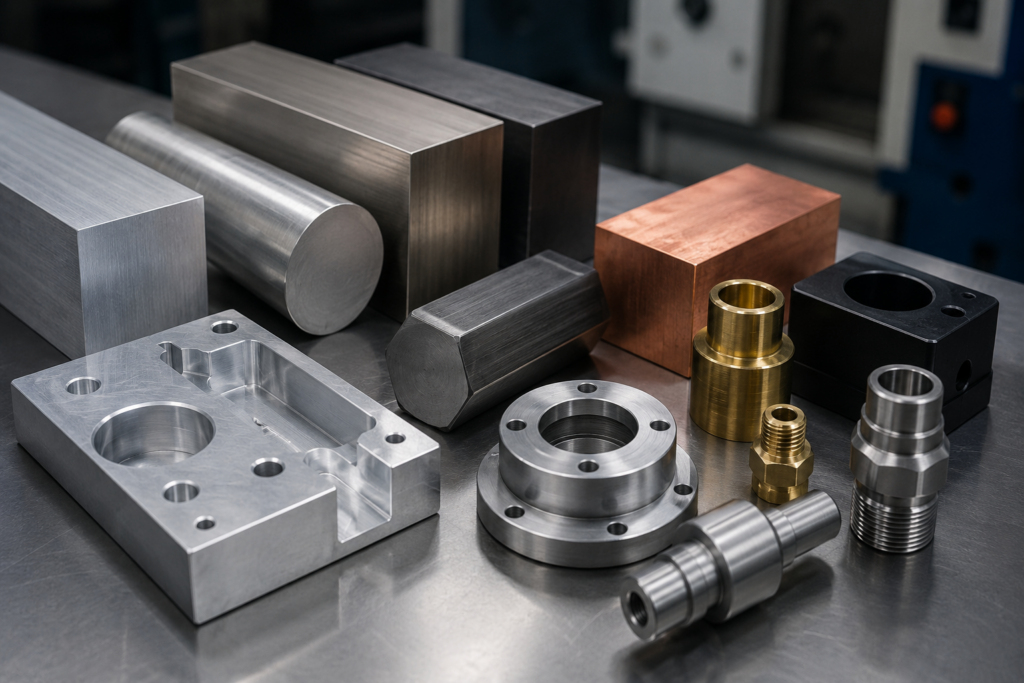
At Perfect Machining, we provide precision metal machining services and custom machining for a wide range of materials, including aluminum, steel, stainless steel, tool steel, copper, brass, and industrial plastics. This allows manufacturers to select the material that best matches their application and production requirements.
Whether you need a prototype, custom metal parts, replacement components, or production quantities, understanding the differences between common CNC machining materials can help you make a better manufacturing decision.
Explore CNC Machining Services in Canada
What Materials Can Be CNC Machined?
CNC machining can be used to manufacture precise components from many metals and engineering plastics. The best material depends on the required strength, dimensions, tolerances, operating environment, weight, corrosion resistance, and intended application.
Common materials used for CNC machining include:
- Aluminum
- Steel
- Stainless steel
- Tool steel
- Brass
- Copper
- Engineering plastics
- UHMW
- Delrin and other machinable plastics
Below is a practical overview of the major material categories used for custom and precision CNC machining.
Aluminum CNC Machining
Aluminum CNC machining is widely used when manufacturers need lightweight components with good machinability, corrosion resistance, and strength-to-weight performance.
Aluminum is commonly selected for components where reducing weight is important without sacrificing dimensional accuracy. It can be machined into complex geometries using CNC milling and turning processes.
Typical applications include:
- Automotive components
- Machine components
- Electrical and electronic parts
- Fixtures and brackets
- Housings and enclosures
- Custom industrial components
Perfect Machining provides aluminum machining for both prototype and production requirements.
Learn more about Aluminum CNC Machining Services
Steel Machining Services
Steel machining services are suitable for applications that require strength, durability, and resistance to mechanical loads. Steel is commonly used for industrial machinery, automotive components, tooling, fixtures, shafts, brackets, and other heavy-duty parts.
Depending on the application, different steel grades can be selected to achieve the required mechanical and manufacturing characteristics.
Steel is particularly useful when a component must withstand repeated loads, impact, wear, or demanding industrial operating conditions.
Stainless Steel CNC Machining
Stainless steel CNC machining is often selected when corrosion resistance, durability, and dimensional accuracy are important. Stainless steel can be used in demanding environments where ordinary steel may not provide the required corrosion resistance.
Common stainless steel applications include:
- Industrial equipment
- Automotive components
- Hydraulic fittings and connectors
- Electrical and electronic components
- Machine components
- Custom stainless steel parts
Depending on the application, grades such as 304, 304L, 316, 316L, and 17-4 PH may be considered.
See Stainless Steel CNC Machining Services in Canada
Tool Steel Machining
Tool steel machining is used for components that require high hardness, wear resistance, and durability. Tool steels are commonly associated with tooling, dies, fixtures, molds, and other components exposed to demanding mechanical conditions.
Machining tool steel requires appropriate tooling, cutting parameters, and process control because its hardness and material properties can make machining more demanding than softer metals.
For manufacturers requiring durable custom components or tooling-related parts, selecting the appropriate tool steel grade is an important part of the manufacturing process.
Plastic CNC Machining & Industrial Plastic Machining
Plastic CNC machining provides an alternative to metal when low weight, chemical resistance, electrical insulation, or specific wear characteristics are required.
Industrial plastic machining can be used for custom components made from engineering plastics such as UHMW and Delrin.
Machined plastic parts are commonly used for:
- Electrical and electronic components
- Wear components
- Guides and bushings
- Insulating components
- Machine components
- Custom industrial parts
Plastic selection should be based on the component’s operating temperature, mechanical load, chemical exposure, dimensional requirements, and application environment.
Copper CNC Machining
Copper CNC machining is useful when electrical and thermal conductivity are important. Copper can be machined into custom components for electrical, electronic, industrial, and specialized applications.
Because copper has different machining characteristics from steel and aluminum, manufacturing parameters should be selected according to the material grade, geometry, tooling, and required surface finish.
Brass Precision Machining
Brass precision machining is commonly used for components where machinability, corrosion resistance, appearance, and dimensional accuracy are important.
Brass can be suitable for fittings, connectors, hardware, bushings, and other custom components.
Its machinability makes brass a practical choice for producing detailed parts efficiently while maintaining the dimensional requirements of the finished component.
How to Choose the Right CNC Machining Material
The lowest-cost material is not always the best choice. Material selection should be based on how the finished part will actually be used.
1. Required Strength
Parts exposed to heavy loads or mechanical stress may require steel, stainless steel, or another high-strength material rather than a lightweight alternative.
2. Corrosion Resistance
If a component will operate in a wet, corrosive, or demanding environment, stainless steel or another corrosion-resistant material may be more appropriate.
3. Weight
When reducing component weight is important, aluminum and engineering plastics can provide useful alternatives to heavier metals.
4. Wear Resistance
Components exposed to friction or repeated contact may require a material with suitable hardness and wear resistance, such as certain tool steels or engineering plastics.
5. Electrical or Thermal Requirements
Electrical and thermal conductivity can make copper or aluminum suitable choices for specific applications.
6. Machining Requirements
The material must also be compatible with the required CNC milling or turning process, geometry, tolerances, tooling, and production volume.
Precision CNC Machining Across Different Materials
Material selection is only one part of producing accurate CNC components. The machining process must also maintain the required dimensions, tolerances, surface finish, and repeatability.
Perfect Machining provides CNC milling and turning capabilities for prototypes, short production runs, and long production runs. CNC milling capabilities include machining components up to 50" × 28" × 20", while CNC turning supports components from approximately 1/8" to 17" in diameter and up to 72" in length.
For customers requiring high precision CNC machining, the manufacturing process can include first article inspection, in-process inspection, and final inspection according to project requirements.
Read the guide to Precision CNC Machining in Canada
Custom CNC Machining for Different Material Requirements
Not every component fits a standard manufacturing specification. Custom CNC machining allows manufacturers to produce components according to customer drawings, dimensions, material specifications, and application requirements.
This is particularly important for custom metal parts manufacturing in Canada, replacement components, machine parts, fixtures, brackets, fittings, and other specialized industrial components.
Depending on the project, CNC machining can support prototypes as well as short and long production runs.
Explore Custom CNC Machining Services in Canada
Which Industries Use CNC Machined Materials?
Different combinations of materials and machining processes are used across a wide range of industries.
- Automotive: custom components, brackets, fixtures, and machine parts
- Electronics: conductive components, housings, connectors, and precision parts
- Electrical: custom components and conductive parts
- Industrial Machinery: shafts, brackets, fixtures, and replacement components
- Hydraulics: fittings, connectors, and precision components
- Defense: application-specific precision components
- Machine Manufacturing: custom parts, assemblies, and production components
The correct material depends on the industry’s performance requirements and the specific function of the component.
CNC Machining Materials for Prototypes and Production
Material requirements can change depending on whether you are developing a prototype or ordering production parts.
For prototypes, the goal is often to manufacture a functional part that accurately represents the intended final component. Using the correct production material can also help validate performance before moving into larger quantities.
For production machining, material availability, repeatability, machining efficiency, dimensional consistency, and total manufacturing cost become increasingly important.
If you are moving from prototype to production, the material and machining process should be reviewed together rather than selected independently.
Learn more about CNC Prototype Manufacturing in Canada
Why Work With a CNC Machining Company in Canada?
Working with an experienced Canadian machine shop can simplify the process of sourcing custom components, particularly when material selection, machining, fabrication, inspection, and production requirements need to be coordinated.
Perfect Machining provides a one-stop manufacturing approach covering CNC machining, fabrication, and conventional machining. The company works with metals and engineering plastics and supports prototype, short-run, and long-run production requirements.
Its manufacturing capabilities include CNC milling, CNC turning, laser cutting, forming, MIG welding, and TIG welding, allowing different manufacturing processes to be combined when required.
View CNC Machining, Fabrication & Manufacturing Capabilities
Get Custom CNC Machined Parts in Canada
The right CNC machining material depends on the component’s function, operating environment, strength requirements, dimensional requirements, production volume, and budget.
Whether you require aluminum CNC machining, stainless steel CNC machining, steel machining, tool steel machining, plastic CNC machining, copper CNC machining, brass precision machining, or custom metal parts, the material and manufacturing process should be evaluated together.
Perfect Machining supports custom CNC machining projects from prototype development through production. Share your drawings, material requirements, quantities, and specifications to discuss the most suitable manufacturing approach for your project.
Looking for precision CNC machining services in Canada?