
When standard components are not suitable for a specific application, custom CNC machining provides a reliable way to manufacture parts according to exact drawings, dimensions, material requirements, and performance specifications.
For manufacturers across Canada, custom machining can be used for everything from one-off prototypes and replacement components to short production runs and high-volume manufacturing. The right machining partner can also help coordinate material selection, CNC milling, CNC turning, fabrication, inspection, and production requirements.
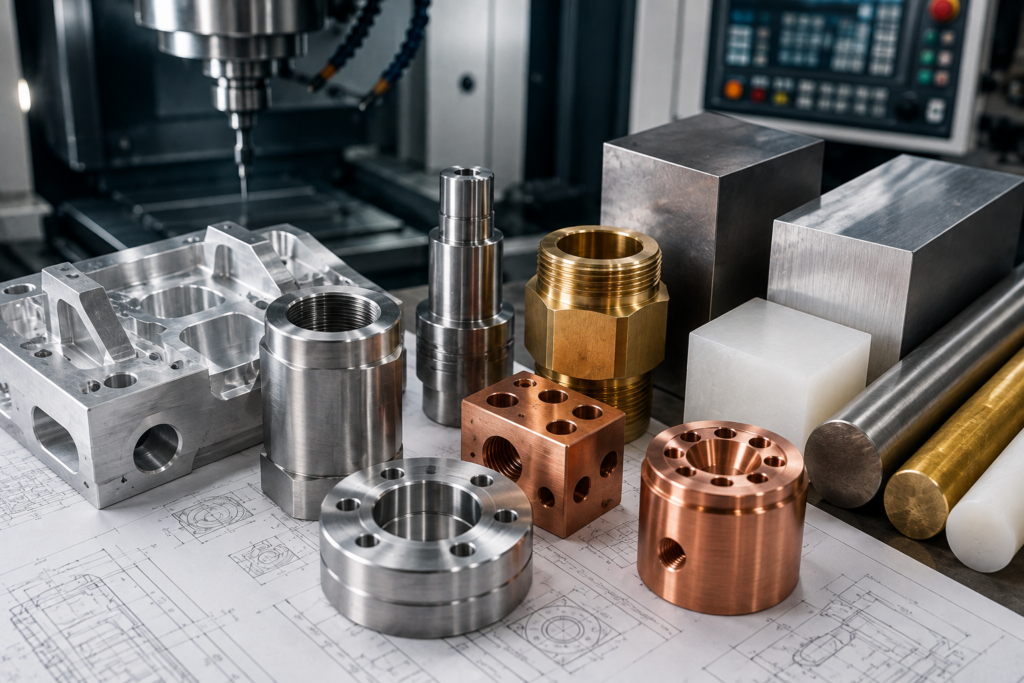
Perfect Machining provides custom CNC machining services in Canada for manufacturers requiring accurately machined metal and plastic components. The company works with materials including aluminum, steel, stainless steel, tool steel, brass, copper, and engineering plastics.
Explore Custom CNC Machining Services in Canada
What Is Custom CNC Machining?
Custom CNC machining is the process of manufacturing components to customer-specific requirements rather than producing standardized off-the-shelf parts.
A custom CNC project may start with a technical drawing, CAD file, sample component, dimensions, material specification, or detailed manufacturing requirements. The machine shop then determines the appropriate machining process, tooling, material, inspection requirements, and production method.
Custom machining is particularly useful when a component has a unique shape, specific tolerance requirements, unusual dimensions, or needs to integrate with an existing machine or assembly.
Custom Metal Parts Manufacturing in Canada
Custom metal parts manufacturing in Canada covers a wide range of components used in industrial equipment, automotive systems, electronics, hydraulics, machine manufacturing, and other applications.
Depending on the design, custom metal parts can be produced through CNC milling, CNC turning, fabrication, laser cutting, forming, welding, or a combination of processes.
Common examples include:
- Machine components
- Brackets and mounting plates
- Shafts and cylindrical components
- Fixtures and tooling components
- Fittings and connectors
- Housings and enclosures
- Replacement machine parts
- Custom industrial components
The manufacturing process should be selected based on the part’s geometry, material, quantity, dimensional requirements, and intended application.
Custom Metal Parts Machining: From Drawing to Finished Component
Custom metal parts machining normally begins with reviewing the customer’s technical requirements. Before production starts, important details such as material, dimensions, tolerances, quantity, surface finish, and inspection requirements should be confirmed.
1. Drawing and Requirement Review
The first step is reviewing the engineering drawing or CAD information. This helps identify critical dimensions, tolerances, material specifications, threads, holes, finishes, and other manufacturing requirements.
2. Material Selection
The material should match the application’s mechanical, environmental, electrical, thermal, and wear requirements. Common choices include aluminum, steel, stainless steel, brass, copper, tool steel, and engineering plastics.
3. Machining Process Selection
Depending on the component, CNC milling, CNC turning, conventional machining, laser cutting, forming, or welding may be required.
4. CNC Machining
The selected material is machined according to the approved specifications. CNC equipment allows complex geometries and repeatable production of custom components.
5. Inspection
Inspection helps verify that the finished component meets the required dimensions and specifications before it is delivered or moved into the next production stage.
CNC Milling and Turning for Custom Parts
Different component geometries require different machining approaches.
CNC Milling
CNC milling is suitable for components requiring features such as pockets, slots, holes, contours, flat surfaces, and complex 2D or 3D geometries.
Perfect Machining’s CNC milling capabilities support components up to approximately 50" × 28" × 20" and include 4th-axis machining for suitable applications.
CNC Turning
CNC turning is commonly used for cylindrical or rotational components such as shafts, pins, fittings, bushings, and similar parts.
Turning capabilities support components from approximately 1/8" through 17" in diameter and up to 72" in length, depending on the project requirements.
For complex projects, milling and turning may be combined with other manufacturing processes.
Custom Industrial Machining for Different Industries
Custom industrial machining is used when standard components cannot meet the requirements of a particular machine, assembly, or industrial application.
Custom machined components can support industries such as:
- Automotive: precision machine components, fixtures, brackets, and replacement parts
- Electronics: custom housings, mounting components, connectors, and precision parts
- Electrical: specialized components and conductive parts
- Hydraulics: fittings, connectors, and machined components
- Machine Manufacturing: custom machine parts and production components
- Defense: application-specific components manufactured to customer requirements
- Industrial Equipment: replacement parts, fixtures, brackets, and mechanical components
The manufacturing approach should always be based on the actual application and engineering requirements rather than simply choosing the lowest-cost machining method.
Custom CNC Machining for Prototypes
CNC prototype manufacturing allows manufacturers to produce a functional physical component before committing to larger production quantities.
A CNC prototype can be used to evaluate dimensions, fit, assembly, functionality, material performance, and design changes before production begins.
Using CNC machining for prototypes can also provide a more realistic representation of the final component when the production part will ultimately be manufactured through CNC processes.
Learn more about CNC Prototype Manufacturing Services in Canada
From CNC Prototype to Production Machining
One advantage of working with a machine shop capable of handling both prototypes and production is that the manufacturing process can evolve as the project develops.
A typical project may follow this path:
- Initial design and engineering review
- CNC prototype manufacturing
- Prototype inspection and testing
- Design or manufacturing adjustments
- Production process planning
- Short production run
- Long production run when required
CNC production machining places greater emphasis on repeatability, process consistency, material availability, inspection, and production efficiency.
Perfect Machining supports prototype, short production, and long production requirements, allowing customers to discuss different manufacturing stages with one supplier.
Materials for Custom CNC Machining
The material selected for a custom component depends on its intended use and performance requirements.
| Material | Common Reasons for Selection |
|---|---|
| Aluminum | Lightweight, machinable, corrosion resistant |
| Steel | Strength, durability, industrial applications |
| Stainless Steel | Corrosion resistance and durability |
| Tool Steel | Wear resistance and demanding tooling applications |
| Brass | Machinability, corrosion resistance, fittings and hardware |
| Copper | Electrical and thermal conductivity |
| Engineering Plastics | Low weight, insulation, wear and chemical resistance |
Material selection should be confirmed against the application’s operating conditions, mechanical loads, environmental exposure, and required tolerances.
Precision Requirements for Custom Machined Parts
Custom components often require more than simply matching the overall dimensions. Critical features may require specific tolerances, surface finishes, hole sizes, threads, concentricity, or positional accuracy.
This makes process control and inspection an important part of precision manufacturing services.
Perfect Machining uses first article inspection, in-process inspection, and final inspection as part of its quality process, with inspection requirements determined according to the project specifications.
Learn more about Precision CNC Machining in Canada
Custom CNC Machining vs. Standard Parts
Standard components can be convenient when an existing product meets the required specifications. However, custom machining becomes more appropriate when the required dimensions, material, geometry, performance, or compatibility are not available from standard parts.
Custom CNC machining can provide:
- Application-specific dimensions
- Material-specific components
- Complex geometries
- Replacement parts for existing equipment
- Prototype development
- Small-batch production
- Repeat production of approved designs
The decision between standard and custom parts should therefore be based on technical requirements, production quantity, lead time, and total project cost.
What to Send a CNC Machine Shop for a Quote
Providing complete project information can make the quoting process faster and more accurate.
When requesting a quote for custom CNC machining, provide:
- CAD files or technical drawings
- Required material and grade
- Part dimensions
- Required tolerances
- Surface finish requirements
- Required quantity
- Prototype or production requirements
- Special inspection requirements
- Required delivery timeline
If some information is not available, the machine shop can review the available drawings and discuss the remaining requirements before production.
Why Choose an Experienced CNC Machining Company in Canada?
Choosing a suitable CNC machining company in Canada is about more than finding a supplier with CNC equipment. Manufacturing experience, material knowledge, inspection processes, production capabilities, and communication can all affect the final result.
Perfect Machining has more than 15 years of experience producing precision parts and provides CNC machining, fabrication, and conventional machining under one manufacturing operation.
The company supports a range of materials and production requirements, from prototypes and short runs to long production runs.
Learn more about Perfect Machining
Get Custom CNC Machined Parts in Canada
Whether you need a single prototype, replacement component, custom industrial part, or repeat production order, custom CNC machining can provide a practical way to manufacture components around your exact requirements.
Perfect Machining supports custom metal parts manufacturing, precision CNC machining, prototype manufacturing, and production machining for customers across Canada.
Send your drawings, material specifications, quantities, and project requirements to discuss the appropriate machining and manufacturing process for your parts.
Need custom CNC machined parts in Canada?