
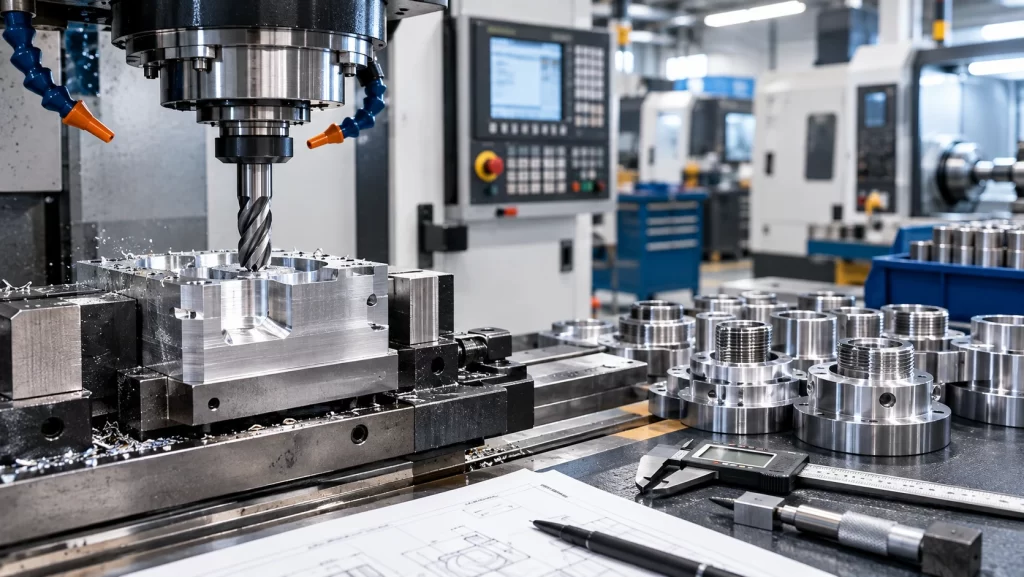
Every dimension of the first part off a new setup gets checked and recorded before the rest of the batch runs. That one habit separates a good first order from a good tenth order.
CNC production machining is about making the same part again and again without drift. Buyers who understand that ask sharper questions and get steadier parts. This guide shows how production runs work, how short, medium and long runs differ, and what to send a shop so your quote comes back accurate.
The short version. CNC production machining is the repeat manufacturing of a proven part design on CNC mills and lathes, with setups, fixtures and inspection planned so every part matches the last one.
What changes when five parts become five hundred
A prototype answers a simple question, which is whether the part fits and works. Production machining answers a harder one. Can the shop make the same part over and over with no change in size or finish?
Once a design is validated, the same CNC programs and setups can move straight into short-run or repeat production. That keeps production parts consistent with the prototype you already tested. Our guide to CNC prototype manufacturing in Canada covers that early stage.
Quantity changes the job in a few ways. Cutting tools wear across a long run, so a cutter that holds size at part one may drift by part four hundred. Cycle time starts to matter, because a few seconds saved per part add up over a full order. Material supply matters too, since a shop needs enough of the same stock to finish the batch.
How setups and fixtures keep every part the same
Repeat work depends on a setup you can trust. A fixture holds the part in the same position every time, and a proven program cuts it the same way every time. Together they take most of the guesswork out of part two, part two hundred and every reorder after that.
Perfect Machining runs CNC milling and CNC turning in house. Parts that need both flat features and round ones stay in one shop, with no hand-off to a second vendor halfway through. That keeps one team responsible for the finished part.
Why the first article check matters so much
Inspection happens at three points in every run, and each point catches a different kind of problem.
First article inspection
This is where a production run is won or lost. Every dimension of the first completed part is measured and recorded on a first-off report. If something is wrong, the shop finds it after one part, not after five hundred. A copy of that report can come with your shipment on request.
In-process inspection
Checks continue during the run. They happen at the start of each operation and while the job cycles, so drift gets corrected early.
Final inspection
Before shipping, a final inspection pulls random samples from the lot and checks dimensions, finishes, coatings and appearance. Where your drawing calls for it, 100% inspection is available.
Short, medium and long runs side by side
Shops often talk about run sizes in loose terms. The table below shows what each one usually means for you. Exact quantities depend on the part, so treat these as guides and not hard lines.
| Run type | Common use | What matters most | What to expect |
|---|---|---|---|
| Short run | Pilot builds, limited releases, design evaluation | Flexibility and quick feedback | Setup carried over from the prototype, first article check on the first part |
| Medium run | Repeat orders on a steady schedule | Consistency from batch to batch | Programs and fixtures reused from the first batch, in-process checks through the run |
| Long run | Ongoing supply for a live product line | Steady cost and dependable delivery | Regular inspection during the run, final sampling on each lot |
Many buyers start with a short run to prove the part and the supplier together. If both work, the same job rolls into repeat orders. Our post on custom CNC machining in Canada shows how that path usually looks from drawing to production.
What sits behind a production job
Milling and turning size limits
Size limits tell you quickly whether a shop can handle your part. The CNC mill covers a work envelope of 50 x 28 x 20 inches and supports 2D, 3D and 4th-axis machining. The lathe turns parts from about 1/8 inch up to 17 inches in diameter and 72 inches long, with a 3 inch spindle through-bore.
Fabrication under the same roof
Many production parts need more than machining. Perfect Machining also offers laser cutting with a 12 kW laser on a 60 by 120 inch bed, metal forming on a 150 ton brake press up to 120 inches wide, and MIG and TIG welding. A part can start as a laser-cut blank, get formed, then move into machining and welding without leaving the building.
Materials and industries
Material range covers aluminum, stainless steel, steel, tool steel, alloy steel, brass, copper and engineering plastics such as UHMW and Delrin. Our CNC machining materials guide explains how to match each one to a part.
Production parts from the Mississauga shop serve automotive, defense, electrical, electronics, hydraulic fittings, hardware and fasteners, and machine manufacturing customers.
What to send for a production quote
A complete request gets you a faster and more accurate quote. Gather these items before you reach out.
- CAD files or drawings
- Material and grade
- Quantity per order and how often you expect to reorder
- Tolerances and critical dimensions
- Surface finish, coating or other secondary operations
- Inspection needs, including a first article report or 100% inspection
- Delivery timeline and release schedule
If a drawing is not final, send what you have. The team can review it and talk through the open points before production starts.
Still deciding who should make your parts? Read how to choose a CNC machining company in Canada before you send out requests. You can also see the full range of CNC machining services in Canada that the shop offers.
Questions buyers ask about production machining
What is CNC production machining?
CNC production machining is the repeat manufacturing of a proven part design on CNC mills and lathes. Setups, fixtures and inspection are planned so every part matches the last one.
How is production machining different from prototyping?
A prototype tests whether a design fits and works. Production machining repeats a validated design in larger quantities, so consistency, tool wear, cycle time and inspection matter much more.
Can Perfect Machining run a short batch before a larger order?
Yes. Perfect Machining supports prototypes, short runs and long production runs. The same CNC programming and setup can move from a short batch into repeat production once the design is validated.
What size parts can be machined?
CNC milling covers a work envelope of 50 x 28 x 20 inches. CNC turning covers parts from about 1/8 inch to 17 inches in diameter and up to 72 inches long, with a 3 inch spindle through-bore.
How are repeat orders kept consistent?
Each run starts with a first article inspection, continues with in-process checks during machining, and ends with a final inspection. A first-off report can be supplied with the shipment on request, and 100% inspection is available where the drawing requires it.
What should I send to get a production quote?
Send CAD files or drawings, the material and grade, the quantity per order, tolerances, finish requirements, inspection needs and your delivery timeline.
How long does a production run take?
Timing depends on the part, material, quantity and any finishing. Send your drawings and quantities, and the team will review them and confirm timing when they quote.
Need repeat CNC parts made in Canada?
Send your drawings, material, quantities and inspection needs. The Perfect Machining team in Mississauga will review them and come back with a quote.
Request a production quotePrefer email? Write to info@perfectmachining.ca.
[…] If the part will be ordered again and again, read our guide to CNC production machining in Canada. […]