
Aluminum is the default material choice for the majority of CNC machined parts because it cuts fast, holds tight tolerances, weighs a fraction of steel, and resists corrosion without secondary treatment. For engineers and procurement teams specifying aluminum CNC machining services, the decisions that matter most are grade selection, tolerance requirements, and finishing — get those right on the drawing and the rest of the process is straightforward. This guide covers how aluminum machines, which grades to specify for which application, what tolerances are realistic, and how to evaluate a Canadian machining partner before committing a production order.
The process details here reflect actual shop-floor capability, not generic marketing claims. Perfect Machining has run aluminum alongside steel, stainless, brass, and copper for over 15 years out of its Mississauga, Ontario facility, and if you’re comparing this against our earlier CNC Machining Services in Canada overview, this article goes deeper specifically into aluminum.
What is aluminum CNC machining?
Aluminum CNC machining is the process of removing material from a solid block or bar of aluminum using computer-controlled milling or turning equipment to produce a precise, finished part directly from a CAD file. Because aluminum is soft relative to steel and generates manageable cutting forces, it can be machined at higher feed rates and spindle speeds than most other metals, which shortens cycle time without sacrificing accuracy. That combination of speed and precision is why aluminum is the material engineers default to unless a specific application demands otherwise.
Why is aluminum the preferred material for CNC machining?
Aluminum is preferred for CNC machining because it delivers the best balance of machinability, strength-to-weight ratio, and corrosion resistance of any commonly available engineering metal. The specific advantages break down as follows:
- Fast cycle times — aluminum’s lower hardness allows higher cutting speeds, reducing machining time and cost compared to steel or stainless steel.
- Excellent strength-to-weight ratio — critical for automotive, aerospace-adjacent, and transportation components where weight reduction matters.
- Natural corrosion resistance — aluminum forms a stable oxide layer without plating, and can be anodized for additional protection.
- Good thermal and electrical conductivity — makes it a common choice for heat sinks, enclosures, and electrical housings.
- Wide finishing compatibility — aluminum accepts anodizing, powder coating, bead blasting, and polishing more readily than most other metals.
These properties are why aluminum shows up across most parts produced through CNC machining services, whether the job is a one-off prototype or an ongoing production run.
Which aluminum grades are used in CNC machining?
Not all aluminum machines or performs the same way, and grade selection should be driven by the part’s mechanical requirements, not just cost. The table below compares the aluminum grades most commonly specified for machined parts.
| Aluminum grade | Key characteristics | Machinability | Typical applications |
| 6061-T6 | Good strength, weldable, corrosion resistant | Excellent — general-purpose standard | Brackets, enclosures, structural components, fixtures |
| 7075-T6 | Highest strength of common grades, lower corrosion resistance | Good — harder on tooling than 6061 | High-stress components, aerospace-adjacent hardware |
| 5052 | Excellent corrosion resistance, good formability | Good — often paired with sheet forming | Marine components, formed and welded assemblies |
| 2024-T3 | High fatigue strength, lower corrosion resistance | Good | Fatigue-critical structural parts |
| 6063 | Lower strength, excellent surface finish and extrudability | Excellent | Architectural and cosmetic components |
When a drawing doesn’t specify a grade, 6061-T6 is the safe general-purpose default — it’s the grade most machine shops stock in the widest range of bar and plate sizes, which also helps lead time.
How does aluminum compare to other CNC machining materials?
Aluminum isn’t always the right choice — material selection depends on strength, weight, corrosion environment, and cost targets. The comparison below sets aluminum against the other materials most commonly requested for custom machined parts.
| Material | Weight | Corrosion resistance | Relative cost | Best fit when |
| Aluminum | Light | Good (excellent when anodized) | Moderate | Weight matters and loads are moderate |
| Stainless steel | Heavy | Excellent | Higher | Corrosive environments, food or medical contact |
| Steel / alloy steel | Heavy | Poor unless coated | Lower to moderate | High strength and load-bearing structure needed |
| Brass | Heavy | Good | Higher | Electrical connectors, decorative or low-friction parts |
For parts that combine multiple materials in one assembly — an aluminum housing with brass fittings, for example — sourcing from a shop that already works across all of these material families avoids splitting a single purchase order across two vendors.
What does the aluminum CNC machining process look like?
The aluminum CNC machining process moves through the same core stages regardless of part complexity, though the equipment used depends on the part’s geometry.
- Design review: the drawing is checked for tolerance callouts, GD&T, and material grade before quoting, catching ambiguity before it becomes a first-article failure.
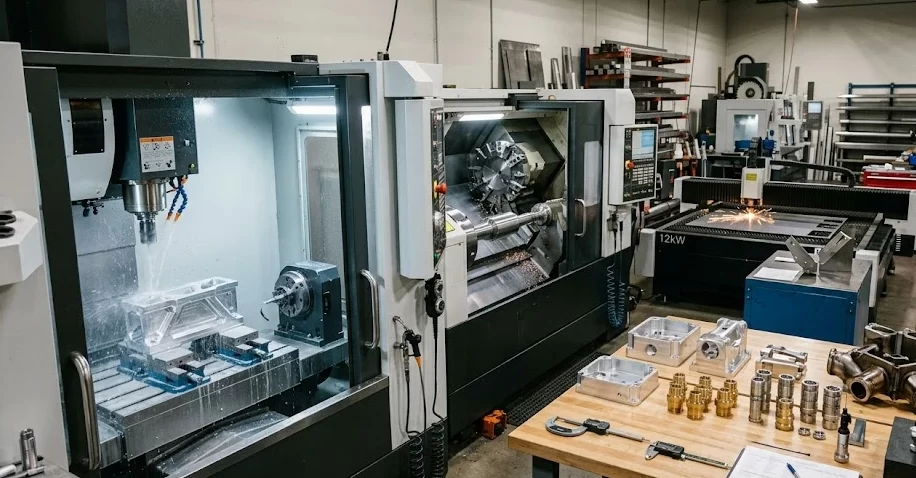
- Milling: for parts with pockets, slots, or contoured features, aluminum blanks are cut on a CNC milling center. Larger aluminum weldments and structural components can run up to 50 by 28 by 20 inches on a CNC machining center, including 4th-axis, 2D, and 3D work.
- Turning: cylindrical aluminum parts — bushings, spacers, fittings — run on a CNC lathe, covering diameters from 1/8″ through 17″ and lengths to 72″.
- Secondary operations: aluminum sheet components can be laser cut and formed before or after machining when a part combines flat and machined features, part of the shop’s broader metal fabrication services.
- Finishing: parts are deburred, and where specified, anodized, bead blasted, or coated.
- Inspection: First Article, in-process, and final inspection confirm the part matches the drawing before shipment.
What tolerances are achievable with aluminum CNC machining?
Aluminum’s machinability allows tighter general tolerances than harder materials without extending cycle time significantly. As a practical guideline, general machined features on aluminum can typically hold ±0.001″ to ±0.005″ depending on feature size and setup, with tighter tolerances achievable on critical dimensions when called out specifically. The tolerance a shop can actually hold depends on machine rigidity, tooling condition, and part fixturing — not just the material — so it’s worth confirming a supplier’s standard tolerance band before assuming a number from a spec sheet applies to your part.
Design tip: only call out tight tolerances on features that functionally require them. Over-specifying tolerance across an entire drawing increases cost and inspection time without improving part function.
What finishing options are available for aluminum parts?
Aluminum’s surface chemistry makes it compatible with more finishing processes than most other machined metals. The table below compares the most common options.
| Finish | Purpose | Appearance | Typical use case |
| As-machined | No secondary treatment | Bright, tool-marked surface | Internal components, prototypes |
| Anodizing (Type II) | Corrosion resistance, color options | Matte, can be dyed | Enclosures, consumer-facing parts |
| Hardcoat anodizing (Type III) | Wear and abrasion resistance | Dark gray to black, matte | Wear surfaces, moving components |
| Bead blasting | Uniform matte texture, removes tool marks | Satin, non-reflective | Cosmetic parts before anodizing |
| Powder coating | Color and added surface protection | Opaque, durable color coat | Enclosures, brackets, visible hardware |
Which industries use aluminum CNC machined parts?
Aluminum machined components show up across nearly every industry that values weight reduction alongside structural performance. The industries most consistently specifying aluminum parts include:
- Automotive — brackets, housings, and jig or fixture components
- Electrical and electronics — enclosures and heat sinks that benefit from aluminum’s thermal conductivity
- Hydraulic fittings and connectors — lightweight turned components where corrosion resistance matters
- Defense — structural and housing components requiring documented inspection records
- Hardware and fasteners — custom aluminum hardware outside standard catalog sizes
These are the same core industries served across the shop’s broader machining and fabrication work, which means the inspection and documentation discipline these sectors expect is already built into the standard process, not treated as a special request.
How is quality controlled on aluminum CNC machined parts?
Aluminum parts follow the same three-stage inspection discipline applied to any material run through the shop, which matters because aluminum’s higher machining speed can mask dimensional drift if inspection isn’t built into the process rather than left to the end.
- First article inspection confirms every dimension on the first completed part against the drawing before the full run proceeds.
- In-process inspection checks dimensions at the start of each operation and through the running cycle to catch drift early.
- Final inspection verifies dimensions, finish, and coating on a sample of the finished lot, with 100% inspection available where specified.
How do you choose a Canadian aluminum CNC machining partner?
Choosing the right supplier for aluminum parts comes down to matching their equipment and material experience to your specific requirements. Use this checklist:
- Confirm they stock or regularly source your specified grade — 6061-T6 availability is standard, but 7075 or 2024 may require lead time confirmation.
- Ask about finishing capability — whether anodizing and coating are done in-house or outsourced affects both cost and lead time.
- Check documented inspection process — First Article, in-process, and final inspection reports should be available on request.
- Confirm equipment size limits against your largest part dimension before quoting.
- Ask whether they handle prototype and production volumes under the same process, avoiding a supplier switch mid-project.
For a broader breakdown of capabilities across all materials and processes, see our CNC Manufacturing Guide, which covers milling, turning, laser cutting, and fabrication capacity in more detail.
Conclusion
Aluminum remains the practical default for CNC machined parts because it combines fast machining, low weight, and strong corrosion resistance with a wide range of finishing options. The variables that actually determine part success are grade selection, tolerance callouts, and finishing requirements — get those specified clearly, and a capable shop can move a part from prototype to production without surprises.
If you have a drawing ready, contact Perfect Machining for a quote, review finished work in the project gallery, or read our Precision CNC Machining Services overview for a full picture of shop capabilities before submitting your part.
Frequently asked questions
Why is aluminum used so often in CNC machining?
Aluminum machines faster than steel or stainless steel, weighs significantly less, resists corrosion without coating, and accepts a wide range of finishes, making it the practical default for most machined components.
What is the best aluminum grade for CNC machining?
6061-T6 is the most common general-purpose grade due to its balance of strength, machinability, and corrosion resistance, though 7075-T6 is preferred for higher-strength applications and 5052 for parts requiring better corrosion resistance or formability.
How tight of a tolerance can be held on aluminum CNC machined parts?
General features on aluminum parts typically hold ±0.001″ to ±0.005″ depending on feature size and fixturing, with tighter tolerances achievable on specific critical dimensions when called out on the drawing.
Is aluminum CNC machining more affordable than steel machining?
Aluminum generally machines faster than steel, which can reduce cycle time and cost, though total cost also depends on material grade, part complexity, and finishing requirements.
Can aluminum parts be anodized after CNC machining?
Yes, anodizing is one of the most common finishing steps for machined aluminum, available in standard Type II for color and corrosion resistance or Type III hardcoat for wear resistance.
What’s the difference between 6061 and 7075 aluminum?
6061-T6 offers a balance of strength, weldability, and corrosion resistance suited to general-purpose parts, while 7075-T6 offers higher strength for demanding structural applications but with reduced corrosion resistance and slightly harder machining.
Can aluminum CNC machining handle both prototypes and production runs?
Yes, a shop with in-house milling and turning capability can typically produce a single aluminum prototype for design validation and then scale to a full production run without re-tooling or switching suppliers.
What information is needed to quote an aluminum machined part?
A shop needs a fully dimensioned drawing with GD&T callouts, the specific aluminum grade, required surface finish, and both prototype and anticipated production quantities.
Which industries rely most on aluminum machined parts?
Automotive, electrical and electronics, hydraulic fittings and connectors, defense, and hardware manufacturing are among the industries that most consistently specify aluminum machined components.
Does aluminum CNC machining require special tooling compared to steel?
Aluminum typically runs with sharper cutting geometries and higher spindle speeds than steel to prevent material buildup on the tool edge, but it does not require specialized machines beyond standard CNC milling and turning equipment.
[…] resistance and good conductivity. Aluminum wins when weight is the main concern, and our guide to aluminum CNC machining services explains the grades. Stainless steel suits harsh chemicals and high strength, and our stainless […]