
If you’re sourcing CNC machining services in Canada, the decision usually comes down to three questions: can the shop hold your tolerances, do they work in your material, and can they scale from a single prototype to a full production run without a quality drop-off. This guide walks through how CNC machining actually works, what separates a capable machine shop from one that will cost you rework, and how to prepare a request for quote that gets you an accurate answer the first time.
Everything below reflects how a working machine shop operates day to day — not marketing language. Perfect Machining has been producing precision parts out of Mississauga, Ontario for over 15 years, and the process descriptions here are drawn from that shop floor experience.
What is CNC machining?
CNC machining is a subtractive manufacturing process where a computer-controlled machine removes material from a solid block or bar stock to produce a precise part. Unlike additive processes, nothing is built up — material is cut away according to a CAD/CAM program until the finished geometry matches the engineering drawing. The two dominant CNC processes are milling, where a rotating cutting tool moves against a stationary workpiece, and turning, where the workpiece rotates against a stationary cutting tool. Most industrial parts require one, the other, or a combination of both.
Why does CNC machining matter for production parts?
CNC machining matters because it produces repeatable, tight-tolerance parts directly from a digital file, without the tooling investment that injection molding or die casting requires. That makes it the practical choice for prototypes, short runs, and mid-volume production where part geometry, material, or tolerance requirements change often. A shop offering CNC machining services for prototype, short-run, and long-run production gives an engineering team flexibility to move a part from concept to a validated production quantity without switching suppliers along the way.
Core capabilities to look for in a machine shop
A capable machine shop should be able to speak to specific equipment and size limits, not just list “CNC machining” as a generic service. The following capabilities are the ones that actually determine whether a shop can run your part.
CNC milling
CNC milling handles parts with complex, non-rotational geometry — pockets, slots, drilled holes, contoured surfaces, and multi-axis features. Milling centers are rated by their working envelope, so it’s worth asking a supplier for their maximum table size before sending a drawing. Perfect Machining’s milling capacity covers components up to 50 by 28 by 20 inches, with 4th-axis, 2D, and 3D machining for extruded, forged, and cast blanks in odd shapes and sizes.
CNC turning
CNC turning is used for cylindrical and rotationally symmetric parts — shafts, bushings, fittings, and fasteners. Turning centers are specified by diameter and length capacity, and by spindle bore for bar-fed work. Bar and shaft work in this range is typically produced on a CNC lathe, running parts from 1/8″ through 17″ in diameter and up to 72″ in length, with a 3″ spindle through-bore for continuous bar feeding.
Laser cutting
Laser cutting is the fastest way to produce flat or profiled sheet metal components before secondary operations like forming or machining. Bed size and laser power determine both the material thickness a shop can cut and the part size they can nest efficiently. A 12kW laser with a 60″ by 120″ bed, cutting up to 1″ thickness, covers the majority of structural and bracket-style sheet parts.
Metal forming
Forming bends flat sheet or plate into a finished profile using a press brake, and is usually paired with laser cutting for parts that start flat and end up as a bracket, enclosure, or structural component. A 150-ton brake press with 120″ of width can form parts to a customer’s drawing without splitting the job across multiple vendors.
Welding
MIG and TIG welding join formed or machined components into a finished assembly, which matters when a part specification calls for a weldment rather than a single machined piece. Having welding under the same roof as milling, turning, and forming removes a handoff point where dimensional accuracy is most often lost.
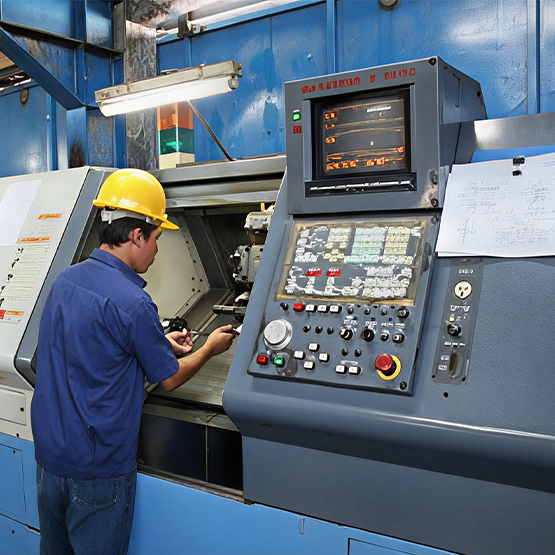
A CNC machining center and a vertical machining center (VMC) are the workhorse equipment behind most of these capabilities, and it’s reasonable to ask a supplier what equipment they’re actually quoting your job on.
Which materials can be CNC machined?
Most industrial metals and engineering plastics can be CNC machined, but machinability, tool wear, and finish requirements vary significantly by material. The table below compares the materials most commonly requested for precision machined parts.
| Material | Typical use case | Machinability | Common finish |
| Aluminum | Lightweight structural and enclosure parts | Excellent — fast cycle times | As-machined, anodized |
| Stainless steel | Corrosion-resistant fittings, food and medical components | Moderate — higher tool wear | As-machined, passivated |
| Steel / alloy steel | Structural brackets, shafts, high-strength components | Good, depends on grade and hardness | As-machined, plated, painted |
| Brass | Fittings, electrical connectors, decorative hardware | Excellent — free-machining | As-machined, polished |
| Copper | Electrical and thermal conductive components | Moderate — gummy, needs sharp tooling | As-machined |
| Engineering plastics (UHMW, Delrin) | Wear parts, low-friction components, prototypes | Excellent — low tool wear | As-machined |
Perfect Machining works across all of these material families, which matters for engineering teams that source multiple materials for the same assembly and would rather not split a purchase order across two suppliers.
Which industries rely on CNC machining services?
CNC machining services support any industry that needs precision metal or plastic components in variable volumes, from a single prototype to an ongoing production schedule. The industries most consistently sourcing custom machined parts include:
- Automotive — brackets, fittings, and jig or fixture components for assembly lines
- Defense — tight-tolerance components with documented inspection records
- Electrical and electronics — connector housings, terminals, and enclosure hardware
- Hydraulic fittings and connectors — turned parts requiring sealing-surface accuracy
- Hardware and fasteners — custom fastener geometries outside standard catalog sizes
A shop that already serves these industries has usually built the inspection discipline these sectors require as a baseline, not an add-on.
How does quality control work in a machine shop?
Quality control in CNC machining is managed through inspection at three checkpoints in the production process, not a single check at the end. This layered approach catches dimensional drift before it becomes scrap.
- First article inspection: every dimension on the first completed part is checked and recorded on a First-Off report, confirming the part matches the customer’s specification before the full run proceeds.
- In-process inspection: dimensions are checked at the start of each operation and again through the running cycle, keeping parts as close to target dimensions as practical rather than catching drift after the fact.
- Final inspection: random samples are pulled from the finished lot and checked against dimensions, finishes, coatings, and overall appearance before packing, with 100% inspection available where a customer specification requires it.
Ask any prospective supplier how they document these three stages — a shop that can produce a First-Off report and a Final Inspection report on request is giving you a paper trail, not just a promise.
Prototype vs. production machining: what’s the difference?
| Factor | Prototype machining | Production machining |
| Quantity | 1–10 units | Dozens to thousands |
| Priority | Speed and design validation | Repeatability and cost per part |
| Programming | Optimized for single-run setup | Optimized for cycle time and tool life |
| Inspection | First article focus | First article plus ongoing in-process checks |
| Typical next step | Design revision or approval for production | Scheduled repeat orders |
A shop offering both prototype and production runs under one roof avoids the re-quoting and re-programming delay that comes from moving a validated design to a different production supplier.
How do you choose a CNC machining supplier in Canada?
Choosing a CNC machining supplier comes down to matching their equipment, material experience, and inspection process to your part’s actual requirements — not the lowest quoted price alone. Use this checklist when evaluating a shop:
- Confirm equipment capacity against your part’s largest dimension, not just their general capability list.
- Ask which materials they run regularly. A shop that machines your material daily will have better tool selection and cycle-time data than one machining it occasionally.
- Request their inspection documentation — First Article, in-process, and final inspection reports should be available, not improvised.
- Check whether they handle secondary operations like welding or forming in-house, which reduces handoff risk on multi-process parts.
- Confirm their engineering drawing review process. A supplier should review GD&T and tolerance callouts before quoting, not after the first part fails inspection.
- Ask about lead time for both prototype and production quantities, since these are usually scheduled differently.
Best practices for getting an accurate CNC machining quote
An accurate quote depends on what you send the shop, not just who you send it to. Following these practices shortens the back-and-forth before a job can start.
- Provide a fully dimensioned drawing with GD&T callouts, not just a 3D model — critical tolerances that aren’t called out are usually assumed to be non-critical.
- Specify the material grade explicitly (e.g., 6061-T6 aluminum, not just “aluminum”).
- State the surface finish requirement, including any coating, plating, or anodizing.
- Note the quantity for both prototype and anticipated production volume, since pricing and lead time differ significantly.
- Flag any features that require special inspection, such as sealing surfaces or press-fit tolerances.
Conclusion
CNC machining services in Canada range widely in equipment capacity, material experience, and inspection rigor, and the difference matters most once a part moves from prototype to production volume. A shop that combines CNC milling and turning, laser cutting, forming, and welding under one roof — backed by documented First Article, in-process, and final inspection — reduces both the number of suppliers you manage and the risk of dimensional surprises on a production run.
If you have a drawing ready, the fastest way to get an accurate answer is to send it directly. Contact Perfect Machining for a quote, browse example work in the project gallery, or review the full machining and fabrication capabilities list before submitting your part.
Frequently asked questions
What is the difference between CNC milling and CNC turning?
CNC milling uses a rotating cutting tool against a stationary workpiece to produce parts with complex, non-rotational geometry, while CNC turning rotates the workpiece against a stationary tool to produce cylindrical parts like shafts and bushings.
How long does a CNC machining quote take?
Quote turnaround depends on drawing completeness — a fully dimensioned drawing with material and finish specified typically gets a faster response than an incomplete model requiring clarification before quoting.
What materials can be CNC machined?
Common CNC machined materials include aluminum, stainless steel, steel, alloy steel, brass, copper, and engineering plastics such as UHMW and Delrin, each with different machinability and finish characteristics.
What’s the minimum order quantity for CNC machining?
Most machine shops that offer prototype runs will quote as few as a single unit, since prototype and short-run machining are priced differently from production-volume orders.
Can one shop handle both prototyping and full production runs?
Yes — a shop with in-house milling, turning, laser cutting, forming, and welding capability can typically carry a part from prototype through production without switching suppliers.
What is First Article Inspection?
First Article Inspection is a documented check of every dimension on the first completed part in a run, confirming it matches the customer’s specification before the rest of the run proceeds.
Do CNC machine shops handle welding and metal forming as well?
Some do — shops that combine CNC machining with MIG/TIG welding and press-brake forming can produce a complete weldment or formed-and-machined assembly without outsourcing a secondary process.
What industries use custom CNC machined parts?
Automotive, defense, electrical and electronics, hydraulic fittings and connectors, and hardware and fastener manufacturers are among the industries that most consistently source custom CNC machined parts.
What information does a machine shop need to quote a part?
A shop needs a fully dimensioned drawing with GD&T callouts, the exact material grade, surface finish requirements, and both prototype and production quantities to provide an accurate quote.
What is the difference between as-machined and finished surface requirements?
An as-machined finish is the surface left directly by the cutting tool with no secondary treatment, while a finished requirement adds a process such as anodizing, plating, passivation, or painting after machining.