
Stainless steel is one of the most frequently specified — and most frequently mis-quoted — materials in precision manufacturing. It costs more to machine than aluminum, wears tooling faster, and punishes a machine shop that doesn’t have the rigidity and process control to handle it correctly. For engineers, purchasing managers, and OEMs sourcing stainless steel CNC machining services in Canada, understanding what separates a shop that machines stainless steel well from one that merely accepts the job can save weeks of rework and scrapped material.
Perfect Machining, based in Mississauga, Ontario, has manufactured precision stainless steel, aluminum, and steel components for over 15 years. We provide CNC milling, CNC turning, laser cutting, forming, and welding services from prototype through long production runs, and we’ve built our process around holding tolerance on harder-to-machine materials like stainless steel, not just softer ones like aluminum. Learn more about our company or browse our product range for the full picture of what we manufacture.
Why Stainless Steel CNC Machining Is Different From Machining Aluminum or Mild Steel
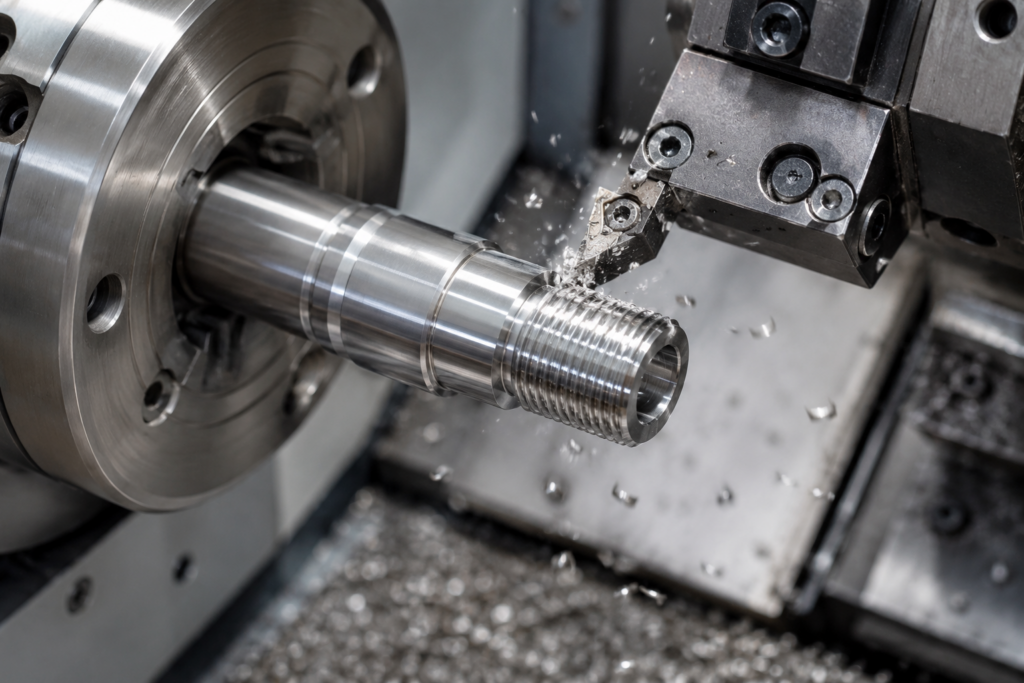
Stainless steel behaves very differently under a cutting tool than aluminum or plain carbon steel. It has lower thermal conductivity, so heat generated at the cutting edge doesn’t dissipate into the chip as quickly — it stays concentrated at the tool tip, accelerating tool wear. It also work-hardens rapidly: if a cutting tool rubs instead of cutting cleanly, the surface layer of the stainless steel hardens on contact, making the next pass harder to cut and increasing the risk of chatter, poor surface finish, or tool breakage.
Because of this, stainless steel machining demands a rigid machine platform, sharp and correctly coated tooling, and carefully calculated feeds and speeds — parameters that differ significantly from an aluminum job on the same machine. A shop set up primarily for softer materials will often quote stainless steel jobs too low, then struggle with tool breakage, missed tolerances, or extended cycle times once the job is running. If you’re comparing this against a softer material for your project, our guide to aluminum CNC machining services covers how that process and cost structure compares.
Stainless Steel Grades We Machine
The right stainless steel grade depends on the part’s operating environment, its strength requirements, and whether it will be welded, plated, or heat treated after machining. The table below summarizes the grades most commonly specified for the parts we produce.
| Grade | Key Properties | Typical Use Case |
|---|---|---|
| 304 / 304L | Good general corrosion resistance, easy to weld, non-magnetic | Enclosures, brackets, fasteners, general fabricated components |
| 316 / 316L | Higher resistance to chlorides and chemical exposure than 304 | Marine hardware, chemical processing components, outdoor electrical hardware |
| 17-4PH | Precipitation-hardening, higher strength and hardness after heat treatment | Shafts, valve components, defense and hydraulic fitting parts requiring higher strength |
Our Stainless Steel CNC Machining Capability
Stainless steel components move through the same CNC milling and turning equipment we use for our other materials, sized to handle both small precision parts and larger fabricated components:
- CNC Milling: Components up to 50″ × 28″ × 20″, including 4th-axis, 2D and 3D machining of extruded, forged, and cast stainless steel blanks with odd shapes and sizes.
- CNC and Conventional Turning: Parts from 1/8″ through 17″ in diameter and up to 72″ in length, on machines with 3″ spindle through-bore.
- Laser Cutting: 12kW fiber laser with a 60″ × 120″ bed, cutting stainless steel sheet and plate up to 1″ thick for flat parts and weldment blanks.
- Forming: 150-ton brake press with 120″ width for forming stainless steel sheet to custom drawings.
- MIG & TIG Welding: For stainless steel weldments and fabricated assemblies that combine machined and formed components.
Every one of these capabilities is detailed on our services page, alongside the quality process we run on every job.
Stainless Steel vs Aluminum vs Steel: Which Material Fits Your Part?
| Factor | Stainless Steel | Aluminum | Mild / Alloy Steel |
|---|---|---|---|
| Corrosion Resistance | Excellent, no coating required for most environments | Good with anodizing, poor bare | Poor unless plated or coated |
| Strength-to-Weight | Higher strength, heavier | Lower strength, much lighter | High strength, heavy |
| Machining Cost | Higher — slower feeds, faster tool wear | Lower — fast cutting, long tool life | Moderate |
| Typical Applications | Hydraulic fittings, food/medical-adjacent hardware, marine and outdoor electrical parts | Electronics housings, lightweight brackets, prototype parts | Structural brackets, defense hardware, high-load components |
| Weldability | Good with correct filler and process control | Requires TIG with specific technique | Straightforward with MIG or TIG |
If your project spans more than one material — for example a stainless fitting mated to an aluminum housing — our CNC machining services buyer’s guide covers how we quote and run mixed-material builds under one production schedule.
Industries We Serve With Stainless Steel Parts
Stainless steel is specified across most of the industries we serve, wherever corrosion resistance, cleanability, or strength after heat treatment matters more than raw weight savings:
- Automotive: Fasteners, brackets, and fittings exposed to road salt and moisture.
- Defense: High-strength components machined to tight tolerance and documented inspection.
- Electrical & Electronics: Enclosures and hardware requiring corrosion resistance and a clean finish.
- Hydraulic Fittings & Connectors: Pressure-rated components where 316 stainless is often specified for chemical or marine service.
- Hardware and Fasteners: Custom fasteners and hardware where standard catalog parts don’t fit the application.
Our Quality Process on Every Stainless Steel Job
Stainless steel parts are unforgiving of drift in dimension across a production run, so every job — prototype or long production — moves through the same three-stage inspection process:
- First Article Inspection: Every dimension on the first completed part is checked and recorded, with a report available on request, before full production continues.
- In-Process Inspection: Parts are checked at the start of each operation and through cycling during the run, keeping dimensions close to target throughout production rather than only at the end.
- Final Inspection: Random samples are pulled from the finished lot, dimensions and finishes verified, and a Final Inspection report created before packing and shipment. 100% inspection is available where customer specifications require it.
Buyer’s Checklist: What to Confirm Before Quoting a Stainless Steel Job
- What grade of stainless steel does the application require — 304, 316, or 17-4PH — based on corrosion exposure and strength?
- Is the part going to be welded, plated, or heat treated after machining, and does the shop have that capability in-house or through a qualified partner?
- What tolerances are critical to function versus cosmetic, so the shop can price the job accurately rather than over-quoting every dimension?
- Is this a prototype quantity that will scale to production, or a one-off — and does the shop run both under the same process?
- What inspection documentation is required with the shipment — First Article Inspection report, material certification, Final Inspection report?
- What is the largest and smallest part in the order set, and does it fit within the shop’s milling and turning envelope?
Get a Quote for Stainless Steel CNC Machining
Send us your drawings, required grade, and quantities — prototype or production — and our team will quote tooling, cycle time, and lead time based on your part geometry and tolerances. We machine stainless steel, aluminum, brass, copper, steel, alloy steel, and plastics under one roof in Mississauga, Ontario.
Explore our capabilities: View services page
Browse our work: View products
See finished parts: View gallery
Call us: (+1) 905-625-2253
Email: info@perfectmachining.ca
Address: 1260 Fewster Dr, Unit 7, Mississauga, ON L4W 1A5, Canada
Frequently Asked Questions
What is stainless steel CNC machining?
Stainless steel CNC machining is the process of milling and turning stainless steel bar stock, plate, or castings into precision parts using computer-controlled equipment. Because stainless steel work-hardens quickly and holds heat at the cutting edge, it requires rigid machines, sharp tooling, and controlled feeds and speeds to hold tolerance without damaging the material or the tool.
Which stainless steel grades can Perfect Machining work with?
We machine 304 and 304L for general corrosion resistance, 316 and 316L for higher chloride and chemical resistance, and 17-4PH for parts needing higher strength after heat treatment. The right grade depends on the part’s environment, strength needs, and whether it will be welded or heat treated after machining.
Why does stainless steel cost more to machine than aluminum?
Stainless steel is harder and less thermally conductive than aluminum, so it generates more heat at the cutting edge, wears tooling faster, and must be cut at lower speeds and feeds to avoid work hardening. These factors increase cycle time and tooling cost per part compared with aluminum CNC machining, even for an identical part geometry.
What tolerances can Perfect Machining hold on stainless steel parts?
We hold tight, repeatable tolerances using in-house CNC milling and turning centres, backed by first article, in-process, and final inspection on every run. Exact achievable tolerance depends on part geometry, wall thickness, and grade, and is confirmed at the quoting stage for each drawing.
Does Perfect Machining offer both prototype and production runs in stainless steel?
Yes. We run prototype quantities as well as short and long production runs on the same equipment and quality process, so a design validated at prototype stage moves directly into production without re-tooling surprises.
What industries use Perfect Machining’s stainless steel CNC parts?
We supply stainless steel CNC machined parts to the automotive, defense, electrical, electronics, hydraulic fittings and connectors, and hardware and fasteners industries, wherever corrosion resistance, cleanability, or post-heat-treatment strength make stainless steel the right choice over aluminum or mild steel.
Where is Perfect Machining located?
We’re located at 1260 Fewster Dr, Unit 7, Mississauga, Ontario, L4W 1A5, Canada, and serve customers across Canada with CNC milling, CNC turning, laser cutting, forming, and welding services. Contact us for a quote.
[…] If the part sits in water, salt or chemicals, stainless steel avoids the rust problem. Our guide to stainless steel CNC machining in Canada covers the 304, 316 and 17-4PH […]