
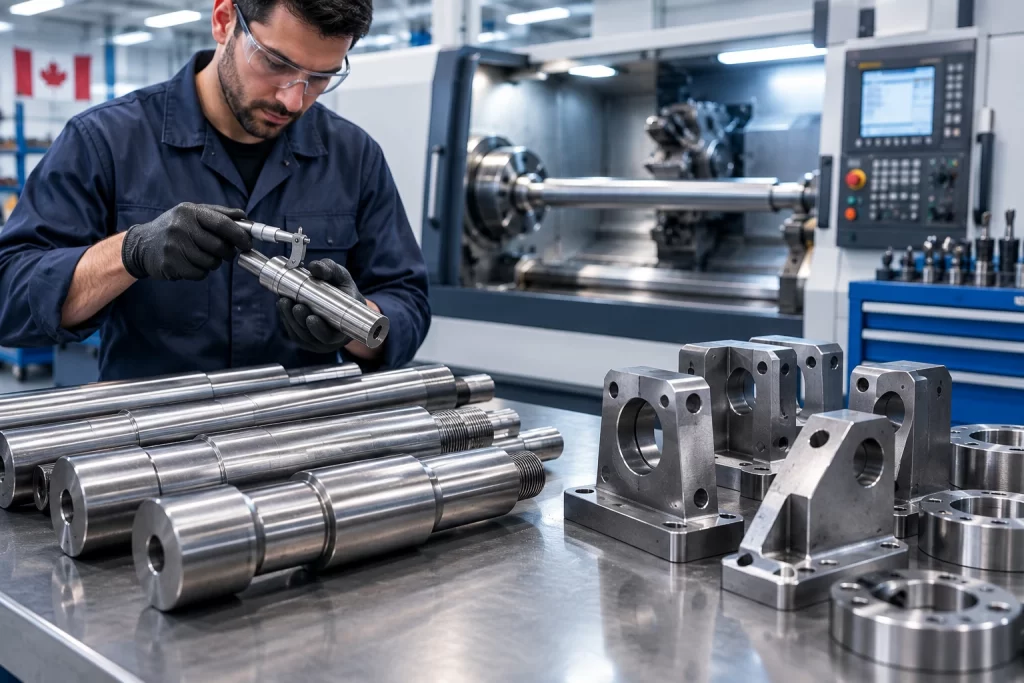
A shaft cut from 1018 steel and one cut from 4140 can look identical on the bench. Under load, they behave very differently.
Steel is the first material engineers pick when a part must carry weight, take a hit or last for years. The type of steel decides whether the part actually does. This guide compares carbon and alloy steel and shows how steel machines. It also lists what to send a shop for an accurate quote.
The short version. Steel machining services cover the turning, milling and fabrication of carbon and alloy steel parts. Carbon steel suits general brackets and shafts. Alloy steel suits parts that need more strength and toughness, often after heat treatment.
Why steel is still the first pick for strong parts
Steel gives you strength, toughness and wear resistance at a price that is hard to beat. That is why it shows up in industrial machinery, automotive parts, tooling, fixtures, shafts and brackets.
It does have limits. Plain steel rusts without protection, and it weighs nearly three times as much as aluminum. When weight or corrosion drives the design, another material may fit better.
Carbon steel and alloy steel side by side
Most steel parts start as either carbon steel or alloy steel. The table below shows how the common types compare. Grades such as 1018, 1045 and 4140 are widely used examples, and the shop will confirm which grades it stocks when you ask for a quote.
| Steel type | Example grade | Strength | Machinability | Typical parts |
|---|---|---|---|---|
| Low carbon steel | 1018 | Moderate | Good | Brackets, pins, fixtures, general shafts |
| Medium carbon steel | 1045 | Higher | Good | Shafts, studs, axles |
| Alloy steel | 4140 | High, with good toughness | Moderate, drops as hardness rises | Heavy shafts, gear blanks, high-load parts |
These ratings are general guides. Actual results depend on the bar condition, hardness and the shape of the part.
Low and medium carbon steel
Low carbon steel such as 1018 machines easily, welds well and costs less than most alloys. It suits brackets, pins, fixtures and general-purpose shafts. Medium carbon steel such as 1045 gives more strength and can be heat treated, so it is a common pick for shafts and studs.
Alloy steel
Alloy steels such as 4140 add elements like chromium and molybdenum. The result is higher strength and better toughness, especially after heat treatment. Parts that see heavy loads, shock or wear often start here.
The tradeoff is harder cutting. The harder the bar, the slower the feeds, so cycle time and tool cost rise. Heat treatment is often done by a specialist partner, so ask how it fits into your lead time.
How steel behaves under the cutting tool
Steel cuts slower than aluminum, so the same part usually costs more to machine in steel. Tools wear faster, and chips run hot. Even so, steel is generally easier to cut than stainless, which hardens as it is machined.
A good shop adjusts speeds, feeds and tooling for the grade and hardness in front of it. It also supports the part well, so thin walls and long shafts do not flex during the cut.
Long shafts are a good example. The CNC lathe at Perfect Machining turns parts up to 72 inches long, with a 3 inch spindle through-bore for bar work. On the milling side, the work envelope is 50 x 28 x 20 inches, including 4th-axis machining.
Rust protection and finishing options
Bare steel starts to rust quickly in damp air. Most steel parts therefore leave the shop with some protection, or get it applied afterwards.
- Oil or rust preventive. Works for parts that will be installed soon after delivery.
- Black oxide. Gives a thin dark finish with light rust resistance.
- Zinc or other plating. Adds stronger protection for parts that face moisture.
- Paint or powder coat. Suits brackets and visible hardware.
Plating and coatings add thickness, so tell the shop at the quoting stage if a fit is tight. Ask which finishes happen in house and which go to a partner.
Steel parts that need more than machining
Many steel parts start as flat plate. Perfect Machining can laser cut sheet and plate on a 12 kW laser with a 60 by 120 inch bed. Cutting capacity runs up to about 1 inch, depending on the material.
Parts can then be formed on a 150 ton brake press up to 120 inches wide and joined with MIG or TIG welding. Machined features go on the same part without a hand-off to another shop.
If the part will be ordered again and again, read our guide to CNC production machining in Canada.
When stainless or tool steel is the better pick
Plain steel is not always the answer. If the part sits in water, salt or chemicals, stainless steel avoids the rust problem. Our guide to stainless steel CNC machining in Canada covers the 304, 316 and 17-4PH grades.
Parts that must resist heavy wear, such as dies, punches and tooling components, often call for tool steel. Our CNC machining materials guide shows how tool steel compares with the other options.
What to send for a steel quote
A complete request gets you a faster and more accurate quote. Gather these items first.
- CAD files or drawings
- Steel grade, or what the part does and what loads it sees
- Heat treatment and hardness target, if any
- Tolerances and critical dimensions
- Finish or coating, such as black oxide or plating
- Quantity per order and how often you expect to reorder
- Inspection needs, including a first article report or 100% inspection
- Delivery timeline
Not sure which steel to pick? Describe the job of the part, and the team can review your drawing and suggest a grade before quoting.
Steel parts from the Mississauga shop serve automotive, defense, electrical, hydraulic fittings, hardware and machine manufacturing customers. You can see the full range of CNC machining services in Canada, or read about custom CNC machining in Canada if your part is a one-off design.
Questions buyers ask about steel machining
What is steel CNC machining?
Steel CNC machining is the milling and turning of steel bar, plate or forged blanks into finished parts on computer-controlled machines. It covers carbon steel and alloy steel, and it can be combined with laser cutting, forming and welding.
Is carbon steel or alloy steel better for CNC machining?
Carbon steel suits general parts that need good strength at a lower cost. Alloy steel suits parts that need higher strength and toughness, often after heat treatment. The right choice depends on load, wear and budget.
Does steel cost more to machine than aluminum?
Usually yes. Steel cuts more slowly and wears tools faster, which adds cycle time. Grade, hardness, part size and finishing also affect the final price.
How do you stop machined steel from rusting?
Steel parts are usually protected with oil, black oxide, plating, paint or powder coat. Tell the shop which finish you need when you request a quote, because coatings can change dimensions.
Can Perfect Machining weld and form steel parts?
Yes. The shop laser cuts, forms and welds steel with MIG and TIG processes, and machined features can be added to the same part.
What size steel parts can be machined?
CNC milling covers a work envelope of 50 x 28 x 20 inches. CNC turning covers parts from about 1/8 inch to 17 inches in diameter and up to 72 inches long, with a 3 inch spindle through-bore.
How are steel parts inspected?
Steel jobs follow the same three steps as other materials. A first article inspection checks every dimension on the first part, in-process checks run during machining, and a final inspection samples the finished lot. 100% inspection is available where the drawing requires it.
What should I send to get a steel quote?
Send CAD files or drawings, the steel grade or the part’s use and loads, any heat treatment or hardness target, tolerances, finish or coating, quantities, inspection needs and your delivery timeline.
Need steel parts machined in Canada?
Send your drawings, steel grade, quantities and finish needs. The Perfect Machining team in Mississauga will review them and come back with a quote.
Request a steel machining quotePrefer email? Write to info@perfectmachining.ca.
[…] Heavy loads, high heat and tight tolerances all point back to metal. For strong, light parts, aluminum is often the answer, and our guide to aluminum CNC machining services explains the grades. For parts that carry heavy loads, read about steel CNC machining in Canada. […]