
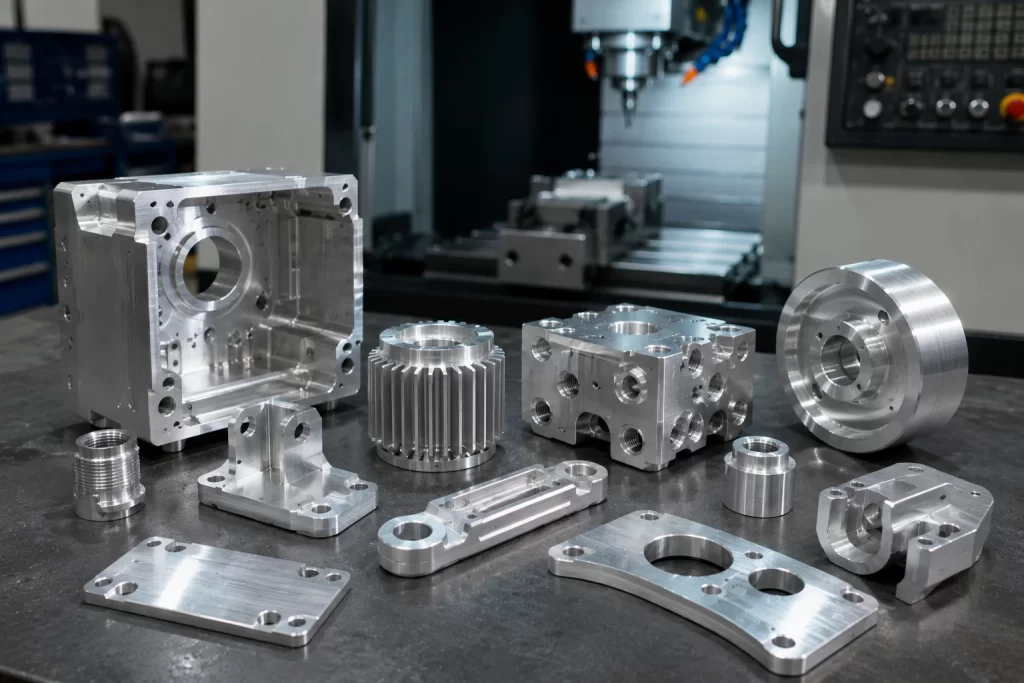
Aluminum is the most widely machined non-ferrous metal in Canadian manufacturing — and for good reason. It machines fast, holds tight tolerances, resists corrosion, and weighs roughly one-third of steel. At Perfect Machining and Services in Mississauga, Ontario, we have spent over 15 years producing precision aluminum components for clients across the automotive, defense, electronics, and hydraulic industries.
Whether you need a single prototype or a long-run production batch, this guide covers everything you need to know about aluminum CNC machining services — the right grade for your application, what tolerances are realistic, how our facility handles your parts, and how to get a quote fast.
Why Aluminum Is the Top Choice for CNC Machined Parts
Engineers and procurement teams across Ontario specify aluminum for machined components more often than any other non-ferrous metal. The material delivers a combination of properties that few alternatives can match:
- High machinability: Aluminum cuts quickly and cleanly, reducing cycle time and tool wear compared to steel. This translates directly into lower per-part cost on CNC milled and turned components.
- Strength-to-weight ratio: Aerospace-grade 7075 aluminum approaches the tensile strength of mild steel at less than one-third the weight — critical for automotive, defense, and electronics enclosures where weight budgets matter.
- Natural corrosion resistance: Aluminum forms a stable oxide layer that protects against moisture and atmospheric corrosion without additional coating — though anodizing or chromate conversion extends this protection further for harsh environments.
- Thermal and electrical conductivity: Aluminum’s conductivity makes it the default material for heat sinks, bus bars, and electronic housings where heat dissipation is a design requirement.
- Versatile finishing: Aluminum accepts anodizing (Type II decorative, Type III hardcoat), powder coating, chemical film (Alodine), and paint — giving designers flexibility that materials like steel cannot always match economically.
For buyers sourcing aluminum CNC machining services in Mississauga, these properties mean faster lead times, more consistent quality, and a per-part cost that stays competitive even at lower volumes.
Aluminum Grades We Machine — and When to Use Each
Not all aluminum behaves the same under a cutting tool. Grade selection has a significant impact on machinability, strength, corrosion performance, and finishing compatibility. Here are the grades we work with most frequently and the applications where each makes sense:
6061-T6 — The Everyday Workhorse
6061 is the most commonly specified aluminum in CNC machining. Its balanced combination of strength (tensile strength approximately 310 MPa), weldability, and excellent corrosion resistance makes it suitable for structural brackets, frames, housings, and general-purpose industrial components. It anodizes cleanly and is widely available in plate, bar, and extrusion form across Ontario suppliers.
6063 — Extrusions and Architectural Profiles
6063 is the standard for extruded profiles — window frames, thermal break sections, and architectural components that require secondary machining. It has lower strength than 6061 but superior surface finish quality after anodizing, making it the first choice when cosmetic appearance matters.
7075-T6 — High-Strength Applications
7075 is the aluminum equivalent of high-strength steel in terms of tensile strength (approximately 503 MPa) and is widely used in defense components, aerospace-adjacent structures, and high-load mechanical parts. It requires more careful machining parameters than 6061 and does not weld well, but where strength and weight savings are the overriding requirement, it is unmatched among aluminum alloys.
2024-T3 — Fatigue-Resistant Structural Parts
2024 is specified where cyclic loading and fatigue resistance are primary concerns. It machines well and is used in structural aerospace and defense applications, though its lower corrosion resistance means it is typically clad or protected with primer and paint.
5052 — Marine and Sheet Applications
5052 is a non-heat-treatable grade with excellent corrosion resistance in saltwater and marine environments. It is commonly machined for enclosures, panels, and brackets in coastal or outdoor applications where 6061 would require additional surface protection.
Not sure which grade is right for your application? Our engineering team reviews every drawing before quoting. Contact us or submit your RFQ through our contact page and we will recommend the optimal grade for your requirements.
Our CNC Machining Capabilities for Aluminum
At our Mississauga facility at 1260 Fewster Dr Unit 7, we operate a full suite of CNC and conventional machining equipment configured to handle aluminum components across a wide size and complexity range.
CNC Milling
Our CNC Machining Centre handles components up to 50″ × 28″ × 20″ in envelope size. Capabilities include 4th axis machining, 2D and 3D contouring, and machining of extruded, forged, and cast aluminum with complex geometry and odd shapes. This makes us a strong fit for multi-feature aluminum housings, manifolds, plates, and structural weldments that need secondary milling.
CNC and Conventional Turning
Our Turning Centre machines aluminum parts from 1/8″ through 17″ in diameter and up to 72″ in length, with a 3″ spindle through-bore on both our CNC and conventional lathe machines. We produce shafts, bushings, fittings, sleeves, and custom turned components in aluminum to print, in prototype or production quantities.
Laser Cutting of Aluminum Sheet
For aluminum sheet and plate, our 12Kw fiber laser with a 60″ × 120″ bed cuts up to 1″ thickness with excellent edge quality and minimal heat-affected zone compared to plasma alternatives. This is particularly efficient for high-quantity flat pattern parts destined for forming or welding.
Forming and Welding
Our 150-ton brake press with a 120″ working width bends aluminum sheet and plate to custom angles and profiles. MIG and TIG welding capabilities allow us to complete aluminum fabrication assemblies in-house, eliminating the need for a second supplier and reducing your procurement overhead.
Tolerances and Surface Finish Options
Precision is not a marketing claim — it needs to be defined in your drawing. Here is what our facility can realistically hold on aluminum CNC machined parts:
| Feature Type | Standard Tolerance | Precision Tolerance |
| Linear dimensions (milled) | ±0.005″ | ±0.001″ |
| Turned diameters | ±0.003″ | ±0.0005″ |
| Hole positions | ±0.005″ | ±0.001″ |
| Flatness | 0.005″ over 12″ | 0.002″ over 12″ |
| Thread class (turned) | 2A/2B | 3A/3B available |
Tighter tolerances are achievable on specific features — always specify the critical dimensions and GD&T callouts on your drawing so we can plan the inspection method accordingly.
Surface Finish Options for Aluminum
- As-machined: Ra 1.6–3.2 μm typical — suitable for most industrial applications
- Deburring and edge breaking: Standard on all shipments unless otherwise specified
- Anodize Type II (decorative): 0.0002″–0.0003″ build — specify before machining so we can account for dimensional change
- Anodize Type III (hardcoat): 0.001″–0.002″ build — used for wear resistance and electrical insulation
- Chromate conversion (Alodine/Iridite): Non-dimensional coating for corrosion protection and paint adhesion
- Powder coating: Available through trusted local finishing partners
Important: If your part requires anodizing or hardcoat, let us know at the quoting stage. We machine critical dimensions to compensate for the coating build-up so your finished part lands on nominal.
Industries We Serve With Aluminum CNC Machined Parts
Our clients span a broad range of industries across Ontario and Canada, all with one thing in common: they need aluminum components produced accurately, on time, and supported by proper documentation.
Automotive
Tier 2 and Tier 3 automotive suppliers in the GTA rely on us for aluminum brackets, housings, manifold bodies, and structural components. Automotive work demands tight tolerances, First Article Inspection reports, and consistent quality across production runs — all standard practice at our Mississauga shop.
Defense
Defense procurement requires material traceability, dimensional documentation, and suppliers who follow structured quality processes. Our three-stage inspection regime — First Article, In-Process, and Final Inspection — aligns with the documentation expectations of defense component buyers.
Electronics and Electrical
Aluminum is the dominant material for electronics enclosures, heat sinks, and chassis components. We machine aluminum housings, connector bodies, and thermal management parts with the surface finish quality and dimensional accuracy that OEM electronics customers require.
Hydraulic Fittings and Connectors
Aluminum fittings for low-to-medium pressure hydraulic systems demand precise thread forms, bore concentricity, and clean sealing surfaces. Our turning centre handles these parts from small diameters through larger body fittings, all verified before shipment.
Hardware and Fasteners
Custom aluminum hardware — knobs, standoffs, spacers, and non-standard fastener bodies — represents some of the most detail-sensitive work we do. Small features, close tolerances, and high cosmetic expectations are the norm, and our team treats every part with the same inspection rigour regardless of complexity.
Our Three-Stage Quality Inspection Process
Every aluminum CNC machined part that leaves our Mississauga facility has passed through three documented inspection stages. This is not optional — it is built into our production workflow on every order.
Stage 1: First Article Inspection (FAI)
The first completed part from every job is measured in full against the print. Every dimension is checked and recorded on a First-Off Report. Customers can request a copy of the FAI report with their shipment — we generate it as standard practice on new parts and on production jobs resuming after a break.
Stage 2: In-Process Inspection
Inspections continue at the start of each operation and at defined intervals during the run. Dimensional checks are recorded throughout — not just at the start. This catches tooling drift, fixture movement, or material variation before it affects your entire batch.
Stage 3: Final Inspection
Prior to packing and shipment, random samples from the lot are pulled and inspected against the final inspection report. Dimensions, finish, coatings, and overall appearance are all verified. Where customer specifications require it, we perform 100% inspection — every single part checked before it goes into a box.
This three-stage process is what our long-term clients in automotive and defense rely on. Quality does not start at the end — it runs through the entire job from quoting to shipping.
How to Get an Aluminum CNC Machining Quote in Mississauga
Getting a fast, accurate quote from Perfect Machining is straightforward. Here is what we need and what to expect:
What to Send Us
- Technical drawing: PDF or DXF/DWG with all dimensions, tolerances, and GD&T callouts
- Material specification: Aluminum grade (e.g. 6061-T6) and any material certification requirements
- Quantity: Prototype quantity and expected production run volume if known
- Surface finish: As-machined, anodize type, coating, or special requirements
- Required delivery date: Helps us plan scheduling and flag any lead time concerns upfront
What Happens Next
Every RFQ received at Perfect Machining is reviewed by an experienced machinist, not just a sales representative. We check the drawing for manufacturability, flag any features that could affect cost or lead time, and return a detailed quote — typically within 1–2 business days for standard aluminum parts.
Contact Perfect Machining
- Address: 1260 Fewster Dr Unit 7, Mississauga, ON L4W1A5
- Phone: (+1) 905-625-2253
- Email: info@perfectmachining.ca
- Quote form: perfectmachining.ca/contact-us
We are located in the heart of Mississauga’s industrial corridor — accessible from Highway 401, Highway 427, and Dixie Road. Clients in Brampton, Oakville, Toronto, and across the GTA are welcome to visit in person to discuss their parts and review material samples.
Frequently Asked Questions About Aluminum CNC Machining
What aluminum grades does Perfect Machining work with?
We regularly machine aluminum grades 6061-T6, 6063, 5052, 7075-T6, and 2024. Each grade is selected based on the application — 6061 for general structural parts, 7075 for high-strength aerospace-grade components, and 6063 for extruded profiles requiring secondary machining.
What tolerances can you hold on aluminum CNC machined parts?
Our CNC machining centre holds tolerances as tight as ±0.001″ on aluminum parts under standard conditions. Our milling envelope covers up to 50″ × 28″ × 20″, and our turning centre handles diameters from 1/8″ through 17″ with lengths up to 72″.
Do you offer aluminum CNC machining for both prototype and production runs?
Yes. We handle everything from single prototypes and first articles through to short and long production runs. Each order goes through First Article Inspection, in-process checks, and final inspection before shipment.
Which industries do you serve with aluminum machined parts?
We supply aluminum machined components to clients in the automotive, defense, electronics, electrical, hydraulic fittings, and hardware industries across Ontario and Canada.
Where is Perfect Machining located and how do I request a quote?
We are located at 1260 Fewster Dr Unit 7, Mississauga, ON L4W1A5. You can reach us at (905) 625-2253 or email info@perfectmachining.ca. Submit your drawing through our contact page for a detailed quote.
Can you machine aluminum parts with complex geometry including 4th axis work?
Yes. Our CNC machining centre supports 4th axis, 2D and 3D machining, and handles extruded, forged, and cast aluminum with odd shapes and sizes — up to 50″ × 28″ × 20″ on the milling side.
What surface finish options are available for aluminum parts?
Options include as-machined, deburring, anodizing Type II and Type III hardcoat, chromate conversion coating (Alodine), and powder coating through finishing partners. Finish requirements should be specified in your drawing at quoting stage so dimensional allowances can be built in where needed.
Ready to get started? Send your drawing to info@perfectmachining.ca or call (905) 625-2253. Perfect Machining and Services has been producing precision aluminum CNC machined parts in Mississauga for over 15 years — and we are ready to quote your next project.