
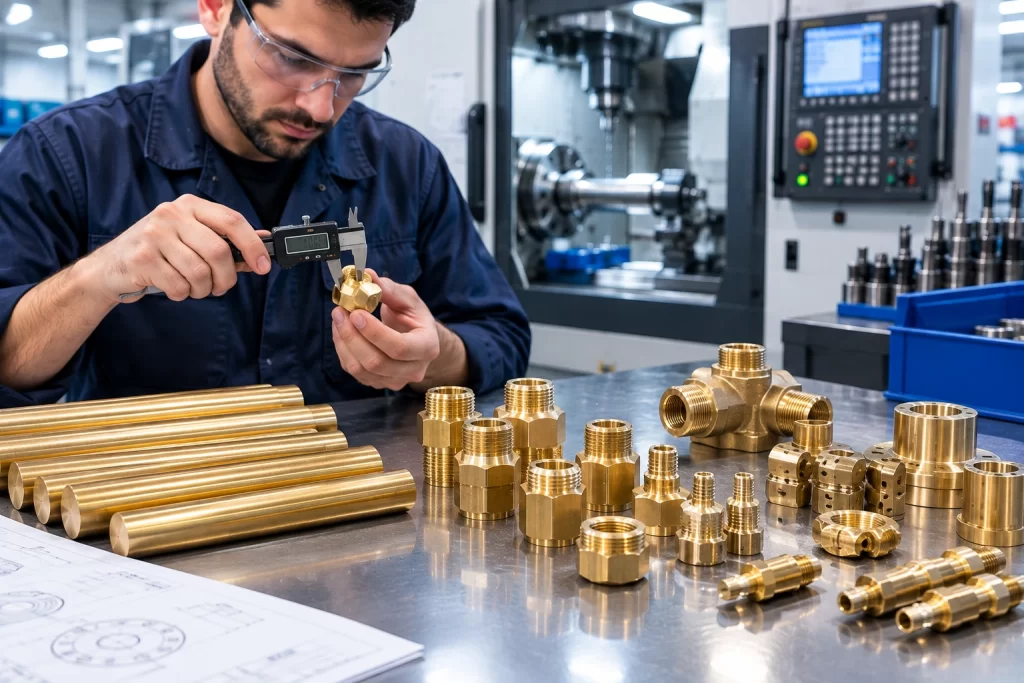
Free-cutting brass sets the 100 percent mark that other metals are rated against for machinability. Chips break into short pieces, tools last longer and the surface finish needs little cleanup.
That makes brass a natural fit for fittings, connectors and small precision parts. This guide covers where brass makes sense and how it compares with aluminum and stainless steel. It also lists what to send a shop for an accurate quote.
The short version. Brass precision machining turns brass bar and rod into fittings, connectors, valve parts and hardware with clean threads and close fits. Brass cuts easily, resists corrosion and conducts electricity well. Parts for drinking water may need lead-free brass, so mention that when you ask for a quote.
Why brass machines so well
Brass is an alloy of copper and zinc. The mix is soft enough to cut cleanly and strong enough to hold sharp threads and crisp edges.
Free-machining grades such as C360 add a little lead, so chips break away instead of tangling around the tool. Operators can run faster feeds, and cycle times drop. That speed keeps per-part cost down on large runs, though brass bar costs more than steel.
C360 is the usual choice for general turned parts, and the shop will confirm which brass alloys it stocks when you ask for a quote.
Brass parts that make sense
Brass shows up wherever a part needs to seal, conduct or look good while it works. Brass CNC machining commonly covers parts like these.
- Fittings and couplings
- Hydraulic and pneumatic fittings
- Valve bodies, stems and seats
- Electrical connectors and terminals
- Bushings and bearing sleeves
- Hardware, inserts and decorative parts
- Instrument and gauge components
The Mississauga shop serves hydraulic fittings, hardware and fasteners, electrical, electronics, automotive, defense and machine manufacturing customers.
Brass compared with aluminum and stainless steel
Fittings and connectors are often made from brass, aluminum or stainless steel. Here is how the three compare.
| Property | Brass | Aluminum | Stainless steel |
|---|---|---|---|
| Machinability | Excellent | Excellent | Moderate, hardens as it is cut |
| Corrosion resistance | Good, especially in water | Good, improves with anodizing | Excellent |
| Strength | Moderate | Moderate, depends on alloy | High |
| Weight | Heavy | Light | Heavy |
| Electrical conductivity | Good | Good | Low |
| Typical parts | Fittings, connectors, valve parts, hardware | Housings, brackets, lightweight parts | Food, marine and chemical-exposed parts |
This is a general guide. The exact alloy and temper change real results.
Brass fits parts that need clean threads, good corrosion resistance and good conductivity. Aluminum wins when weight is the main concern, and our guide to aluminum CNC machining services explains the grades. Stainless steel suits harsh chemicals and high strength, and our stainless steel CNC machining guide covers 304, 316 and 17-4PH.
What to check before you choose a brass grade
Drinking water and lead
Free-machining brass contains a small amount of lead. Parts that touch drinking water usually need a lead-free alloy instead. If your part is for potable water, say so when you request a quote and check the rules for your application.
Strength and wear
Brass is strong enough for most fittings and connectors, but it is softer than steel. It can dent or wear under heavy loads or repeated contact. For those jobs, steel is usually the better call, and our guide to steel CNC machining in Canada explains the options.
Harsh water and chemicals
In some water conditions, plain brass can lose zinc over time, a problem called dezincification. Special alloys resist it. Mention aggressive water, salt or marine use so the right alloy gets picked from the start.
Threads, tolerances and finishes to put on the drawing
Brass holds fine threads well, but threads are also where fittings fail. Spell them out clearly on the drawing.
- Thread standard, size, class and length, such as NPT or metric
- Sealing surfaces and the finish they need
- Critical diameters and tolerances
- Finish, such as as-machined, polished or plated
Plating and polishing are common on brass hardware, so say which you need. Ask which finishes happen in house and which go to a partner.
Fittings often need cross holes, flats and hex features too. The CNC lathe at Perfect Machining has a 3 inch spindle through-bore for bar work, and the mill supports 4th-axis machining. Round and flat features can come from one shop.
What to send for a brass quote
A complete request gets you a faster and more accurate quote. Gather these items first.
- CAD files or drawings with thread callouts
- Brass alloy, or what the part does and what it touches
- Any lead-free requirement
- Tolerances and critical dimensions
- Finish or plating needs
- Pressure or leak testing needs, so the shop can tell you how they are handled
- Quantity per order and how often you expect to reorder
- Inspection needs, including a first article report or 100% inspection
- Delivery timeline
Not sure which alloy to pick? Describe the job of the part, and the team can review your drawing and suggest one before quoting. Our CNC machining materials guide also compares brass with its close relative, copper.
Fittings are usually ordered in volume. Read our guide to CNC production machining in Canada to see how repeat orders stay consistent. You can also see the full range of CNC machining services in Canada.
Questions buyers ask about brass machining
What is brass precision machining?
Brass precision machining uses CNC mills and lathes to turn brass bar and rod into finished parts such as fittings, connectors, valve parts and hardware, with clean threads and close fits.
Why is brass so easy to machine?
Brass is soft enough to cut cleanly, and free-machining grades break chips into small pieces. That means longer tool life, faster cutting and a good surface finish.
Do brass parts for drinking water need lead-free brass?
Often yes. Free-machining brass contains a small amount of lead, so parts that touch drinking water usually need a lead-free alloy. Tell the shop about the use when you request a quote, and check the rules for your application.
Should I choose brass or stainless steel for fittings?
Brass cuts faster and works well for water, air and oil fittings. Stainless steel is stronger and handles harsher chemicals and conditions better.
Can brass hold fine threads and tight tolerances?
Yes. Brass is stable and cuts cleanly, so it holds fine threads and close tolerances well. Share your thread callouts and critical dimensions so the shop can plan inspection.
What size brass parts can be machined?
CNC milling covers a work envelope of 50 x 28 x 20 inches. CNC turning covers parts from about 1/8 inch to 17 inches in diameter and up to 72 inches long, with a 3 inch spindle through-bore.
How are brass parts inspected?
Brass jobs follow the same three steps as other materials. A first article inspection checks every dimension on the first part, in-process checks run during machining, and a final inspection samples the finished lot. 100% inspection is available where the drawing requires it.
What should I send to get a brass quote?
Send CAD files or drawings with thread callouts, the brass alloy or the part’s use, any lead-free requirement, tolerances, finish or plating, quantities, inspection needs and your delivery timeline.
Need brass parts machined in Canada?
Send your drawings, brass alloy, thread details and quantities. The Perfect Machining team in Mississauga will review them and come back with a quote.
Request a brass machining quote
Prefer email? Write to info@perfectmachining.ca.