
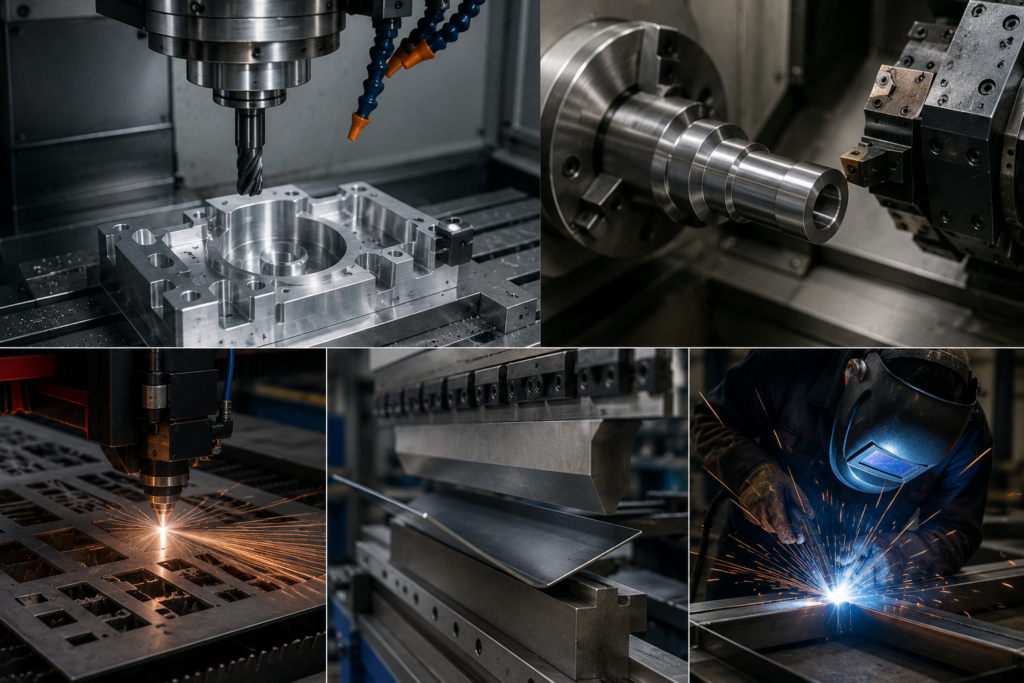
Modern manufacturers often need more than a basic machining service. Depending on the component, a project may require CNC milling, CNC turning, laser cutting, forming, welding, fabrication, inspection, or a combination of several manufacturing processes.
Understanding how these processes work can help manufacturers choose the right CNC machining company in Canada for prototypes, custom components, replacement parts, and production requirements.
Perfect Machining provides CNC machining, fabrication, and conventional machining for customers requiring precision manufacturing services across a range of metals and engineering plastics.
Explore CNC Machining Services in Canada
What Is CNC Machining?
CNC machining uses computer-controlled equipment to remove material from a workpiece and create a component according to a digital design or technical drawing.
Unlike manual machining, CNC equipment can follow programmed toolpaths to produce repeatable components with controlled dimensions and complex geometries.
CNC machining is commonly used for both prototype development and production manufacturing. The appropriate process depends on the part’s geometry, material, dimensions, tolerances, quantity, and application.
Common CNC Machining Processes
The two primary CNC machining processes used for many custom components are CNC milling and CNC turning. Other manufacturing processes can be combined with CNC machining when required.
CNC Milling
CNC milling uses rotating cutting tools to remove material from a stationary workpiece. It is suitable for parts requiring pockets, slots, holes, contours, flat surfaces, and complex 2D or 3D features.
Depending on the machine configuration, milling can also support machining of complex shapes and features from different orientations.
Perfect Machining’s CNC milling capabilities include 4th-axis machining and support components up to approximately 50" × 28" × 20".
CNC Turning
CNC turning is primarily used for rotational components. During turning, the workpiece rotates while cutting tools remove material to create the required diameter, profile, grooves, threads, and other features.
Typical turned components include:
- Shafts
- Pins
- Fittings
- Bushings
- Cylindrical machine components
- Custom rotational parts
Perfect Machining supports turning from approximately 1/8" through 17" in diameter and up to 72" in length, depending on project requirements.
CNC Milling vs. CNC Turning: Which Process Do You Need?
The best machining process depends primarily on the geometry of the component.
| Requirement | Typical Process |
|---|---|
| Pockets and slots | CNC milling |
| Complex 3D contours | CNC milling |
| Flat machined surfaces | CNC milling |
| Shafts and pins | CNC turning |
| Cylindrical components | CNC turning |
| Threads and turned diameters | CNC turning |
| Complex components requiring multiple processes | Milling + turning and/or fabrication |
Some custom components require both milling and turning before the finished part meets the drawing requirements.
Metal Fabrication Services and CNC Machining
Not every component can be manufactured entirely through CNC machining. Larger sheet-metal components, brackets, frames, panels, and fabricated assemblies may require additional processes.
Metal fabrication services can include processes such as laser cutting, forming, and welding.
Laser Cutting
Laser cutting can be used to produce accurately cut profiles from sheet and plate material. Perfect Machining operates a 12 kW laser with a 60" × 120" bed and cutting capability up to approximately 1" thickness, depending on material and application.
Forming
Forming can shape sheet and plate components according to the required design. Perfect Machining has a 150-ton brake press with capacity up to approximately 120" in width.
MIG and TIG Welding
Welding can be used to join fabricated components or create assemblies that cannot be produced as a single machined part.
Perfect Machining provides both MIG and TIG welding as part of its fabrication capabilities.
View CNC Machining and Fabrication Capabilities
Precision Metal Machining Services
Precision metal machining services are required when components must consistently meet specified dimensions and tolerances.
Precision does not simply mean making a part as small or accurate as possible. The required level of precision should be determined by the engineering drawing and the function of the component.
Critical factors can include:
- Dimensional tolerances
- Hole size and location
- Thread specifications
- Part geometry
- Surface finish
- Material properties
- Inspection requirements
- Production repeatability
A capable machine shop should review these requirements before production rather than assuming that every component requires the same machining tolerances.
High Precision CNC Machining for Critical Components
High precision CNC machining becomes particularly important when small dimensional variations can affect assembly, fit, movement, sealing, or overall component performance.
For these projects, manufacturing should include appropriate process control and inspection throughout production.
Perfect Machining’s quality process can include First Article Inspection, in-process inspection, and final inspection, with inspection requirements determined by the project specifications.
For more information about precision machining requirements:
Read the Precision CNC Machining Guide
Choosing CNC Machining Materials
The machining process must be considered together with material selection. Different materials behave differently during cutting and can require different tooling, speeds, feeds, and manufacturing approaches.
Common materials used for CNC machining include:
- Aluminum
- Steel
- Stainless steel
- Tool steel
- Brass
- Copper
- Engineering plastics
- UHMW
- Delrin
For example, aluminum may be selected where low weight is important, while stainless steel can be appropriate where corrosion resistance is required. Tool steel may be considered for wear-resistant applications, while engineering plastics can be useful where low weight, insulation, or specific wear characteristics are needed.
Read the CNC Machining Materials Guide
CNC Machining for Electronics Industry
CNC machining for the electronics industry can be used to manufacture custom housings, brackets, mounting components, connectors, fixtures, and other precision parts.
Electronics-related components may require tight dimensional control because parts often need to fit within compact assemblies or interface with other components.
Material selection can also be important. Aluminum, copper, brass, stainless steel, and engineering plastics may be considered depending on the component’s mechanical, electrical, thermal, and environmental requirements.
CNC Machining for Industrial Equipment
Industrial equipment manufacturers often require custom components that are not available as standard off-the-shelf products.
Custom industrial machining can be used for:
- Machine components
- Replacement parts
- Fixtures
- Brackets
- Shafts
- Fittings
- Mounting components
- Custom tooling components
For replacement parts, the machine shop may need to work from an engineering drawing, CAD model, physical sample, or detailed measurements depending on the project.
CNC Machining for Prototypes and Production
The manufacturing process can change depending on whether you need a prototype or production quantities.
CNC Prototype Manufacturing
CNC prototype manufacturing allows manufacturers to test a physical version of a component before committing to larger quantities.
Prototypes can help verify dimensions, fit, functionality, assembly, and design before production.
Explore CNC Prototype Manufacturing Services
CNC Production Machining
CNC production machining focuses on producing repeatable components in larger quantities while maintaining consistent quality and process efficiency.
Production planning can involve material sourcing, machining strategy, tooling, inspection, setup optimization, and repeatability.
For manufacturers requiring both prototype and production components, using one supplier can simplify the transition from initial development to repeat orders.
How to Choose a CNC Machining Company in Canada
Choosing the right CNC machining company in Canada requires more than comparing the price of a single part.
Before selecting a supplier, consider:
- Available CNC milling and turning capabilities
- Material experience
- Maximum component sizes
- Prototype and production capabilities
- Fabrication capabilities
- Inspection and quality procedures
- Experience with your industry
- Ability to handle custom requirements
- Communication and quoting process
A supplier with machining and fabrication capabilities under one operation can also be useful when a project requires multiple manufacturing processes.
What Information Should You Provide for a CNC Quote?
A detailed quote request helps the machine shop understand the project and determine the appropriate manufacturing process.
Whenever possible, provide:
- CAD files or technical drawings
- Material and material grade
- Part dimensions
- Required tolerances
- Surface finish requirements
- Quantity
- Prototype or production requirements
- Inspection requirements
- Target delivery schedule
The more complete the information, the easier it is to evaluate machining requirements and provide an accurate manufacturing proposal.
Why Work With Perfect Machining?
Perfect Machining provides a combination of CNC machining, fabrication, and conventional machining for manufacturers requiring custom components.
Its capabilities include CNC milling, CNC turning, 4th-axis machining, laser cutting, forming, MIG welding, and TIG welding.
The company works with materials including steel, stainless steel, aluminum, tool steel, brass, copper, and engineering plastics and supports prototypes, short production runs, and long production runs.
This combination allows customers to discuss machining and fabrication requirements with one manufacturing partner rather than coordinating every process separately.
Get CNC Machining and Fabrication Services in Canada
The right manufacturing process depends on the component’s geometry, material, dimensions, tolerances, quantity, and application.
Whether you require precision CNC machining, custom CNC machining, CNC milling, CNC turning, metal fabrication, prototype manufacturing, or production machining, choosing a supplier with the appropriate equipment and manufacturing experience can help simplify your project.
Perfect Machining supports custom manufacturing requirements from prototype development through production.
Have a drawing or custom part that needs to be manufactured?