
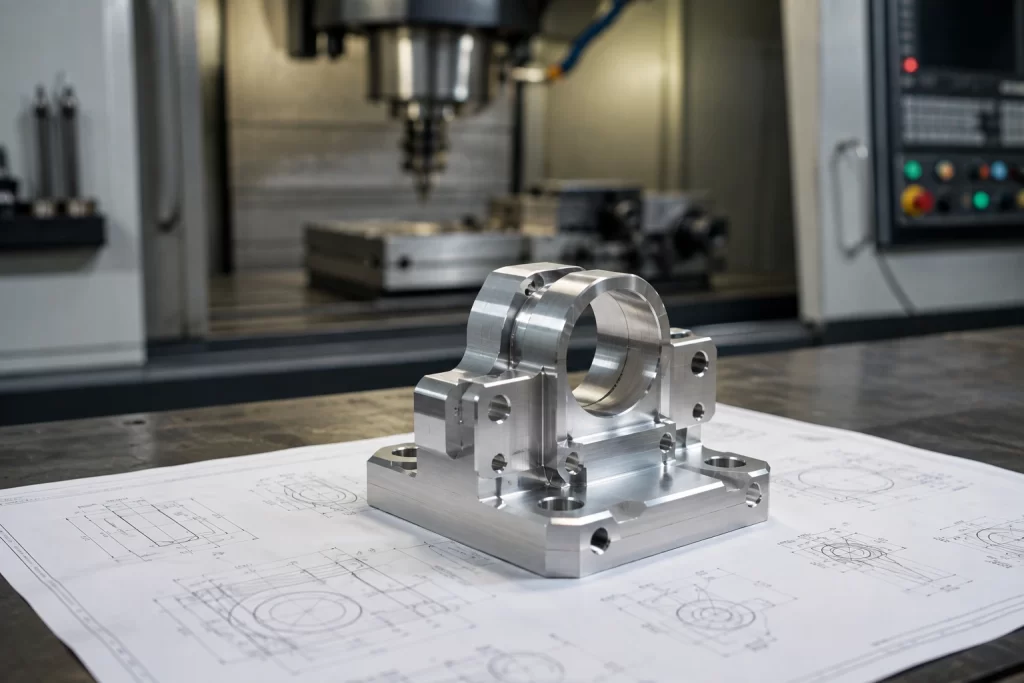
The gap between a CAD drawing and a working metal part is where most manufacturing risk hides. A design that looks correct on screen can fail on a fixture, bind against a mating part, or turn out to be unmachinable in the material specified — and finding that out after a 500-piece production order has been cut is expensive. CNC prototype manufacturing closes that gap by putting a real, machined part in an engineer’s hands before production quantities are committed to.
Perfect Machining, based in Mississauga, Ontario, runs prototype, short, and long production runs on the same CNC milling, turning, laser cutting, forming, and welding equipment, in the same materials, following the same quality process. That means a prototype approved with us doesn’t need to be re-validated on different machines when the order scales — it moves straight into production. Learn more about our company or see examples of finished work in our gallery.
Why CNC Prototype Manufacturing Matters Before a Production Order
A prototype run exists to answer questions a drawing alone can’t: Does the part actually fit its mating components? Does the wall thickness hold up once machined rather than modeled? Does a tolerance that looked achievable on paper turn out to be difficult to hold consistently in the chosen material? Catching these issues on one or two parts costs a fraction of what it costs to discover them across a full production batch — or worse, after parts have shipped to an end customer.
Prototype machining also validates manufacturability itself. A feature that’s easy to model in CAD — a deep narrow pocket, an internal thread close to a wall, a tight radius in a hard material — can be difficult or impossible to machine reliably. Running the part through the same process planning used for production surfaces these problems while the design can still be changed cheaply.
CNC Prototype vs 3D Printed Prototype: When to Use Each
| Factor | CNC Machined Prototype | 3D Printed Prototype |
|---|---|---|
| Material | Actual production material — metal or engineering plastic | Polymer or resin, rarely matches production material |
| Mechanical Properties | Represents real strength, stiffness, and wear behaviour | Does not represent metal strength or machining behaviour |
| Surface Finish | Matches or is close to production finish | Layer lines typical, usually requires post-processing to compare |
| Best Use | Fit, function, tolerance validation, manufacturability check | Quick form check, visual mockup, low-cost early iteration |
| Path to Production | Same process and equipment scales directly to production | Separate process — production still requires CNC or other tooling |
Where a design is still changing rapidly and the question is purely “does this shape work,” a 3D print is often the faster, cheaper first pass. Once a design is close to final and the question shifts to “will this part perform and machine correctly in the actual material,” a CNC prototype is the appropriate next step — and it’s the step that carries directly into production with us.
Materials Available for Prototype and Production Runs
We machine prototypes in the same material range we use for production, so the prototype accurately represents what a production order will deliver:
- Stainless Steel — 304, 316, and 17-4PH for corrosion resistance or post-heat-treatment strength. See our stainless steel CNC machining guide for grade selection.
- Aluminum — for lightweight housings, brackets, and electronics enclosures. See our aluminum CNC machining guide.
- Steel and Alloy Steel — for structural and high-load components.
- Brass and Copper — for electrical, hydraulic, and fitting applications requiring conductivity or corrosion resistance.
- Plastics — including UHMW and Delrin, for low-friction, chemical-resistant, or lightweight parts.
From Prototype to Production: How the Process Carries Through
A common failure point in prototyping happens when a prototype is machined by one shop — or on a rapid-prototyping process like 3D printing or a job-shop lathe — and production is then quoted separately by a different manufacturer using different equipment and tooling. Small discrepancies in tolerance, finish, or fit can appear that weren’t present in the approved prototype, because the production process isn’t actually the same one that was validated.
Running both stages through the same shop removes that gap:
- Same Equipment: Prototype and production parts are cut on the same CNC milling centres (up to 50″ × 28″ × 20″) and turning centres (1/8″ through 17″ diameter, up to 72″ length) — nothing is re-programmed for a different machine class between stages.
- Same Inspection Process: First Article Inspection on the prototype becomes the baseline for In-Process and Final Inspection once production begins, with a report available on request at every stage.
- Same Material Sourcing: The grade and supplier of material used for the prototype carries forward, avoiding a switch that could change machining behaviour or mechanical properties at production scale.
Our CNC machining services buyer’s guide covers how we structure quoting and scheduling once a prototype is approved and a production quantity is confirmed.
Industries That Rely on CNC Prototype Manufacturing
- Automotive: Validating brackets, fittings, and custom hardware before production tooling commitments.
- Defense: Prototyping components to tight tolerance ahead of qualification testing.
- Electrical & Electronics: Fit-checking enclosures and hardware against PCB and assembly tolerances.
- Hydraulic Fittings & Connectors: Confirming thread engagement and sealing surfaces before a production run.
- Hardware and Fasteners: Validating custom fastener geometry that doesn’t exist in a standard catalog.
What to Prepare Before Requesting a Prototype Quote
- A 2D drawing with critical dimensions and tolerances called out, or a 3D CAD file (STEP is preferred).
- The material grade required — and whether it must match a specific production spec.
- Quantity needed for prototype, and the anticipated production quantity if the part is expected to scale.
- Any post-processing required: welding, plating, heat treatment, or specific surface finish.
- Whether a First Article Inspection report is required with the shipment.
- Target timeline for the prototype and, if known, the target timeline for the production order.
Get a Quote for Prototype or Production CNC Machining
Send us your drawing or CAD file along with material and quantity, and we’ll quote your prototype on the same equipment and process that will run your production order — no re-validation later. We machine stainless steel, aluminum, brass, copper, steel, alloy steel, and plastics under one roof in Mississauga, Ontario.
Explore our capabilities: View services page
Browse our work: View products
See finished parts: View gallery
Call us: (+1) 905-625-2253
Email: info@perfectmachining.ca
Address: 1260 Fewster Dr, Unit 7, Mississauga, ON L4W 1A5, Canada
Frequently Asked Questions
What is CNC prototype manufacturing?
CNC prototype manufacturing is the process of machining a small quantity of parts — often a single unit — directly from a CAD drawing using computer-controlled milling and turning equipment, before committing to a full production run. It lets an engineer check fit, function, and manufacturability on a real part before ordering production quantities.
How is CNC prototyping different from 3D printing a prototype?
A CNC-machined prototype is cut from the actual production material — metal or engineering plastic — so it represents real strength, finish, and machining behaviour. A 3D printed prototype is built in layers from polymer or resin and is useful for a quick form check, but doesn’t represent the mechanical properties or machinability of the final metal part.
Can Perfect Machining move a prototype directly into production?
Yes. We run prototype and short-run parts on the same CNC milling and turning equipment used for long production runs, with the same first article, in-process, and final inspection at every stage. An approved prototype doesn’t need to be re-validated on different equipment when the order scales.
What materials can be used for a CNC prototype?
We machine prototypes in stainless steel, aluminum, brass, copper, steel, alloy steel, and plastics including UHMW and Delrin. The prototype material should match, or closely represent, the material planned for production so results carry over accurately.
How long does a CNC prototype take to manufacture?
Lead time depends on part complexity, material availability, and current shop load, and is confirmed at the quoting stage after drawing review. Because prototypes run on the same equipment as production rather than a separate rapid-prototyping process, timelines are quoted per job.
What information does Perfect Machining need to quote a prototype part?
A 2D drawing with dimensions and tolerances, or a 3D CAD file, along with required material, quantity, and any post-processing such as welding, plating, or heat treatment. Noting the anticipated production quantity at this stage helps with process planning.
Does Perfect Machining provide inspection reports on prototype parts?
Yes. A First Article Inspection report checking every dimension against the drawing can be provided with a prototype shipment on request, giving documented confirmation before a production order is placed. Contact us to get started.
[…] That keeps production parts consistent with the prototype you already tested. Our guide to CNC prototype manufacturing in Canada covers that early […]
[…] is also a quick way to test a fit or a shape before you commit to metal. Our guide to CNC prototype manufacturing in Canada shows how that early stage […]